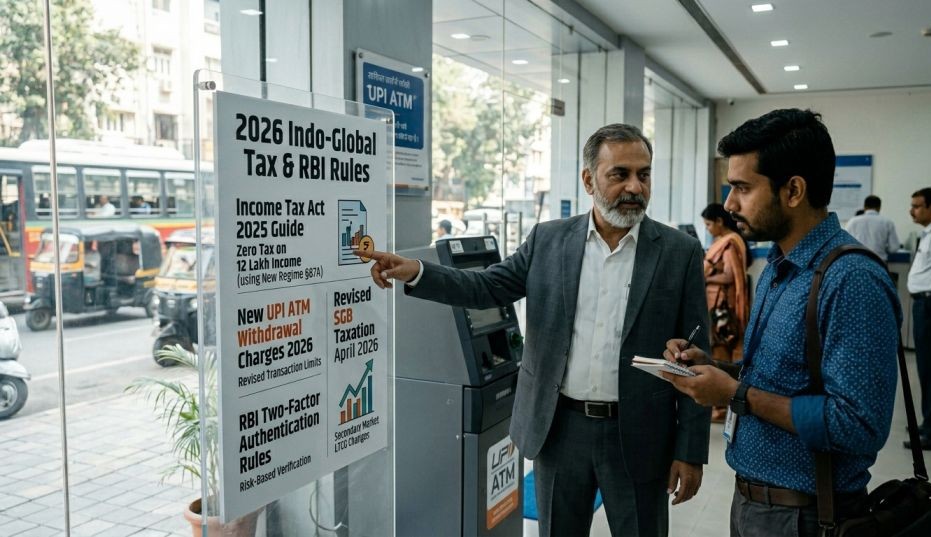
The Income Tax Act 2025 Guide is no longer just a technical manual; it is the definitive roadmap for every Indian taxpayer navigating a radically shifted financial landscape. As we move deeper into 2026, the transition to the New Tax Regime as the default has fundamentally altered how we perceive "taxable income."
With the introduction of the Zero Tax on 12 Lakh Income threshold, the middle class has been handed a powerful tool for wealth preservation—but only if they understand the fine print. From the New UPI ATM Withdrawal Charges 2026 to the updated RBI Two-Factor Authentication Rules, the way we move, save, and protect our money has reached a new level of complexity.
Key Takeaways: The 2026 Financial Snapshot
- Effective Zero Tax: Thanks to the revised Section 87A rebate of ₹60,000, those earning up to ₹12.75 Lakh (including standard deduction) pay absolutely nothing under the New Tax Regime.
- Banking Friction: UPI-based ATM withdrawals now count toward your monthly free transaction limit at major banks like HDFC.
- Transaction Security: The RBI’s new AFA (Additional Factor of Authentication) rules now mandate dynamic, risk-based verification for every digital payment.
- SGB Pivot: Secondary market Sovereign Gold Bonds have lost their tax-free redemption status as of April 1, 2026.
You may also read :- Types of Banking in India: A Complete Guide to Banking System
Decoding the Zero Tax on 12 Lakh Income
For years, the "Seven Lakh" mark was the holy grail for tax-free living in India. That’s ancient history. The Income Tax Act 2025 Guide has codified a massive leap.
The Real-World Scenario: The "12.75 Lakh" Hack
Consider Rohan, a software lead in Pune earning ₹12,75,000 annually. Under the old rules, he’d be scrambling for insurance receipts and home loan certificates. In 2026, he simply opts for the New Tax Regime.
- Standard Deduction: He subtracts ₹75,000 immediately. Taxable income: ₹12,00,000.
- The Rebate: His calculated tax on ₹12 Lakh is exactly ₹60,000.
- The Result: Section 87A kicks in with a full ₹60,000 rebate. Total tax? Zero.
The 'Hot Take': Why "Zero Tax" is a Psychological Trap
We often celebrate "Zero Tax," but here’s the counter-intuitive truth: The New Tax Regime encourages consumption over long-term forced savings. By removing the incentive for 80C deductions (LIC, PPF, ELSS), the government is betting that you’ll spend that extra liquidity to boost the economy. Our advice? Don't stop your SIPs just because the taxman isn't "forcing" you to save.
Technical 'Under-the-Hood' Details: Marginal Relief
What happens if you earn ₹12,05,000? In the past, earning ₹5,000 extra could cost you ₹60,000 in tax. The 2025 Act fixes this with Marginal Relief. Your tax will never exceed the amount you earned over the ₹12 Lakh limit. It’s an elegant, albeit complex, calculation that prevents the "success penalty."
Note :- If your income is between ₹12 Lakh and ₹13 Lakh, always use a Marginal Relief calculator before filing. A ₹10,000 bonus shouldn't lead to a ₹40,000 tax bill.
New UPI ATM Withdrawal Charges 2026: The End of Free Cash?
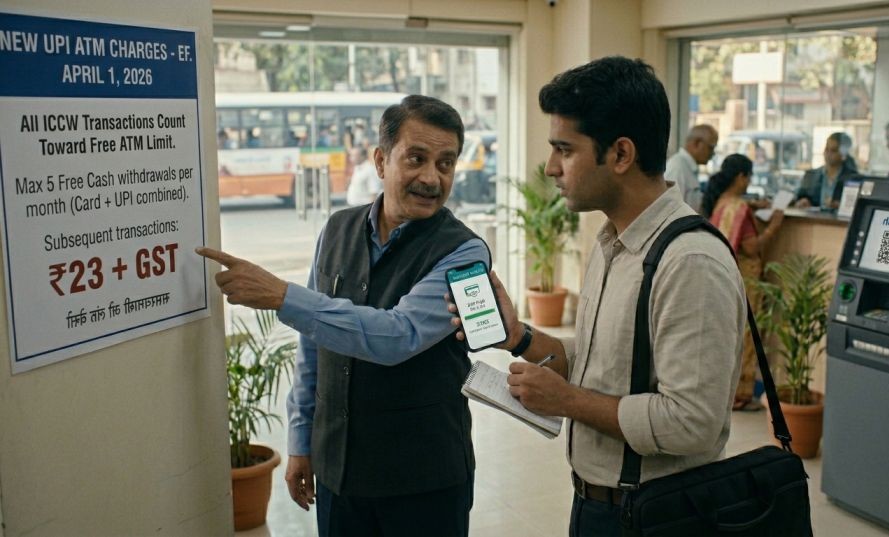
We’ve all grown fond of scanning a QR code at an ATM and walking away with cash—no card required. But as of April 1, 2026, the honeymoon phase is over.
Real-World Scenario: The Weekend Cash Run
Imagine you’re in a Tier-2 city like Indore. You’ve used your debit card 3 times this month. On Saturday, you use the "UPI Cash" feature twice to avoid carrying your wallet. Under the New UPI ATM Withdrawal Charges 2026, those two "cardless" transactions just exhausted your free limit. Your next withdrawal? That will be ₹23 + GST.
The 'Hot Take': Banks are Penalizing "Cardless" Tech
It feels like a step backward, right? Why charge for a more secure, cardless technology? The reality is cost recovery. ATM maintenance and cash logistics in India remain expensive. Banks are subtly nudging us toward a "Cashless-Cashless" society—where you don't just leave your card at home, you leave the physical cash there too.
Technical 'Under-the-Hood' Details: ICCW Integration
Interoperable Cardless Cash Withdrawal (ICCW) uses the IMPS/UPI switch to authenticate. While it’s technically a "digital" transaction, it triggers a "physical" fulfillment. Banks now categorize the "Request for Cash" as a standard ATM hit in their core banking systems (CBS) to maintain parity between physical and digital access.
RBI Two-Factor Authentication Rules: Security vs. Friction
The RBI has moved from "Rule-based" to "Risk-based" security. The new RBI Two-Factor Authentication Rules effective from April 1, 2026, mean your phone is about to get a lot busier.
Real-World Scenario: The "Unusual" Midnight Purchase
You’re buying a high-end camera from an overseas site at 2 AM. Normally, an OTP would suffice. Now, the system sees the "Time," "Location," and "Value" as high-risk. You might be prompted for a biometric scan on your banking app plus a dynamic OTP. It’s annoying. It’s slow. But it’s the reason your account won't be drained by a scammer in another time zone.
The 'Hot Take': We are the "Unpaid Security Officers"
By mandating 2FA for every transaction, the RBI is effectively shifting the burden of security onto the consumer. If you share that second factor, the bank’s liability disappears. We aren't just users anymore; we are the final firewall.
Technical 'Under-the-Hood' Details: Contextual Data points
Under the 2026 framework, "Authentication" isn't just a password. It’s a triplet of Knowledge (PIN), Possession (Smartphone), and Inherence (Fingerprint). At least one factor must be dynamic (like a time-bound OTP or a sliding token).
Revised SGB Taxation April 2026: The Golden Transition
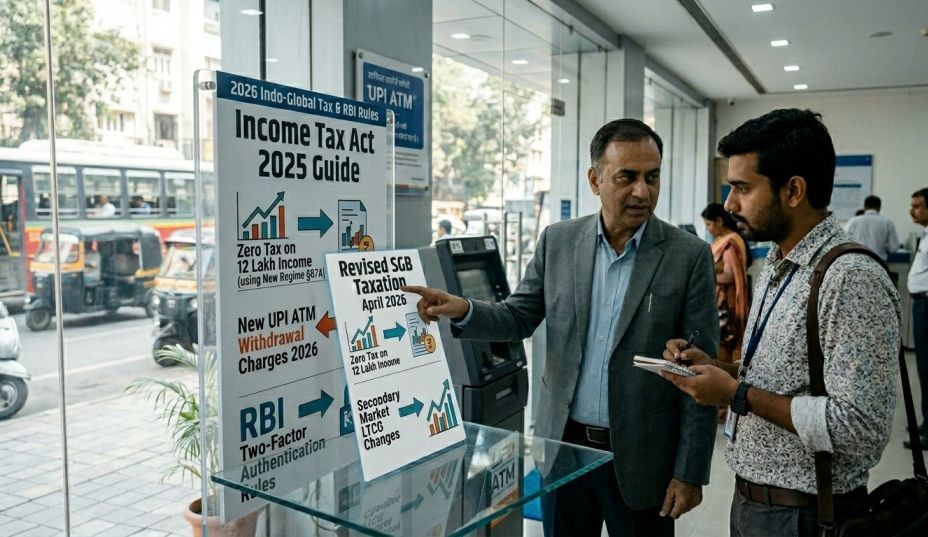
Sovereign Gold Bonds (SGBs) were once the "Perfect Investment." Not anymore. The Revised SGB Taxation April 2026 rules have split the market in two.
Real-World Scenario: The Secondary Market Shock
Amit buys an SGB on the NSE (secondary market) in May 2026. He holds it for 5 years until maturity. He expects tax-free returns. He’s wrong. Because he didn't buy it during the "Original Issue" (Primary Market), he’ll pay 12.5% Long-Term Capital Gains (LTCG) on the appreciation.
The 'Hot Take': The Government Wants You "Locked In"
The tax-free benefit is now a reward for loyalty, not just for "owning gold." By taxing secondary market buyers, the RBI is discouraging "flipping" bonds and rewarding those who subscribe directly during the initial window. It makes SGBs less like a tradable commodity and more like a long-term pension fund.
Note:- Always check the "Issue Date" and "Original Subscriber Status" before buying SGBs on an exchange. If it's not a primary subscription, factor in the 12.5% tax hit when calculating your CAGR.
FAQ: Punchy Answers for the 2026 Taxpayer
Q: Do I really pay zero tax if I earn ₹12 Lakhs?
A: Yes, provided you use the New Tax Regime. The combination of the ₹4 Lakh basic exemption and the enhanced Section 87A rebate wipes out the liability for taxable income up to ₹12 Lakh.
Q: Will UPI ATM withdrawals always cost money?
A: No. They are free until you hit your bank's monthly limit (usually 3 to 5 transactions). After that, the New UPI ATM Withdrawal Charges 2026 apply, typically ₹20–₹25 per hit.
Q: Does the new RBI 2FA rule apply to small tea-stall payments?
A: Technically, yes, but the RBI allows for "Risk-Based" exceptions. Small, frequent payments from "Trusted Devices" may skip the second layer to keep things fast.
Q: Is the 2.5% SGB interest also tax-free?
A: No. The interest is always taxable as "Income from Other Sources" based on your slab. Only the capital gains (profit from gold price increase) can be tax-free for primary holders.
 in India.webp)