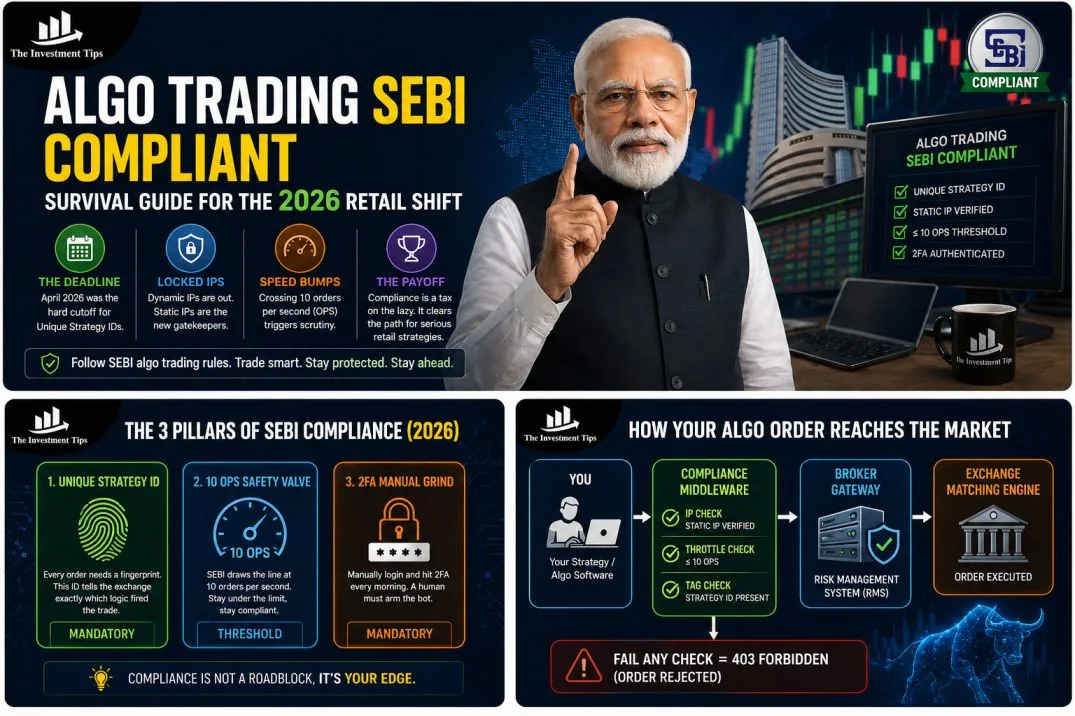
The Indian market hit a wall on April 1, 2026. If you're a retail player, the old "wild west" of API trading is officially over. Navigating Algo Trading SEBI Compliant protocols isn't just about avoiding a ban anymore—it’s about whether your orders even reach the matching engine. Whether you're running a lean Python script or a bloated dashboard, SEBI now watches every byte.
The Bottom Line
- The Deadline: April 2026 was the hard cutoff for Unique Strategy IDs.
- Locked IPs: Dynamic IPs are out. Static IPs are the new gatekeepers.
- Speed Bumps: Crossing 10 orders per second (OPS) triggers institutional-grade scrutiny.
- The Payoff: Compliance is a tax on the lazy. It clears the path for serious retail strategies.
The Real Deal on Algorithmic Trading India
For a long time, algorithmic trading India felt like a hack. We used unofficial bridges and looped TradingView alerts into brokers like it was a game. Not anymore. SEBI’s 2026 framework turned the "rules" into hard-coded roadblocks.
The "Monday Morning" Nightmare
It’s 9:15 AM. Your Bank Nifty scalper is primed. But the logs show Connection Refused. Why? Your ISP rotated your IP address at midnight. Under the current sebi algo trading rules, your broker’s gateway saw an "untrusted" source and killed your session. Game over before the first tick.
Pro-Tip: Forget Home Broadband Professional automation needs a VPS in Mumbai (like AWS South-1). It keeps your Static IP locked and your latency under 5ms. If you're trading from a home laptop, you're bringing a knife to a rail-gun fight.
Breaking Down the SEBI Algo Trading Rules
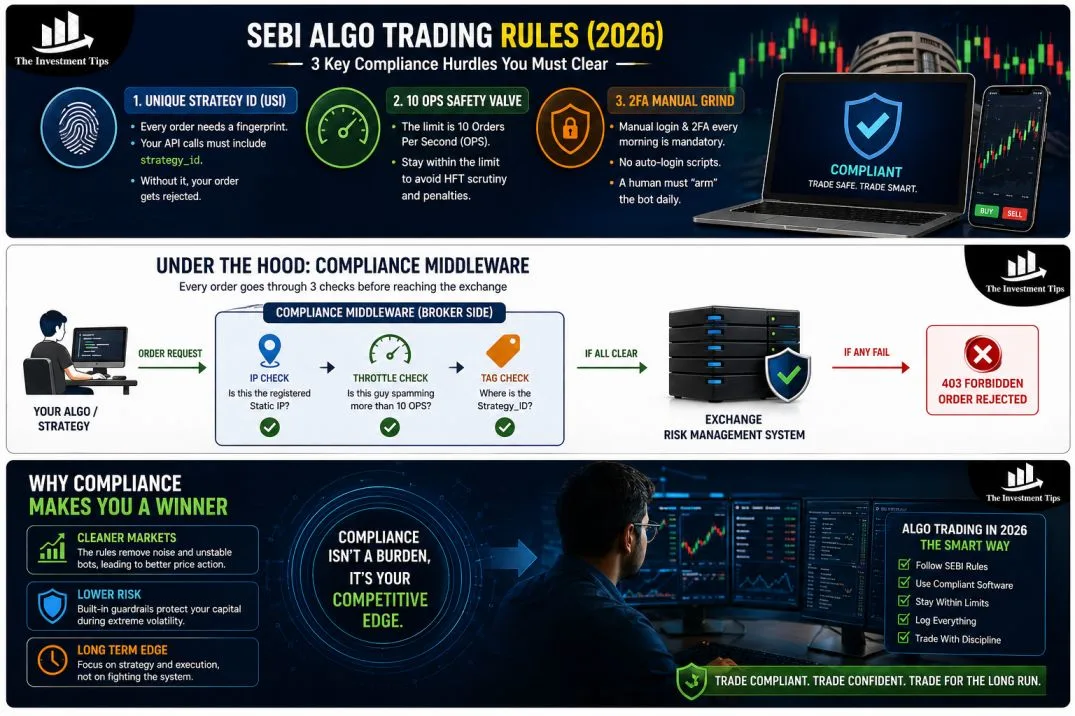
SEBI isn't trying to stop you from making money. They’re trying to stop your bot from breaking the exchange. To stay Algo Trading SEBI Compliant, you’ve got three big technical hurdles to clear right now.
- The Unique Strategy ID (USI)
Every order needs a fingerprint. This ID tells the exchange exactly which logic fired the trade.
- The Tech: Your API calls now need a strategy_id field. Leave it blank? The RMS (Risk Management System) rejects it instantly.
- The 10 OPS Safety Valve
Think you need high-frequency speed? You don’t. SEBI draws the line at 10 orders per second.
- Hot Take: Retail traders chasing HFT speeds are usually just burning brokerage. The real money in 2026 is made in the "mid-frequency" zone—one trade every few minutes. Let the big firms fight over the microseconds.
- The 2FA Manual Grind
The "set it and forget it" dream is dead. You have to manually login and hit that 2FA every single morning. No auto-login scripts allowed. SEBI wants a human to "arm" the bot. It’s annoying, but it prevents runaway scripts from draining your account while you’re at brunch.
Is Algo Trading Profitable in 2026?
Every one asks: is algo trading profitable now that the costs are higher?
The Short Answer: Yes. But only because the "noise" is gone. The new rules flushed out the "get-rich-quick" crowd using broken scripts. This makes price action cleaner for the rest of us.
A Case Study in Volatility
Last February, a mid-cap dump triggered a wave of unoptimized retail bots. They sold at "market" and caused a mini-flash crash. Traders using the best algo trading software in india with built-in SEBI risk limiters were fine. Their bots paused when the volatility spiked. The "cheap" bots got liquidated.
Ranking the Best Algo Trading Software in India
Don't just look at the UI. In 2026, you look at the "Empanelment" list.
- The Coder’s Choice: Zerodha Kite / Angel One SmartAPI. Still king for Python/Node.js users.
- The No-Code Entry: AlgoTest or Tradetron. They handle the "Compliance Wrapper" so you don't have to.
- The Hybrid: Quantman. Great for moving from manual charts to cold, hard rules.
Under the Hood: The Compliance Middleware
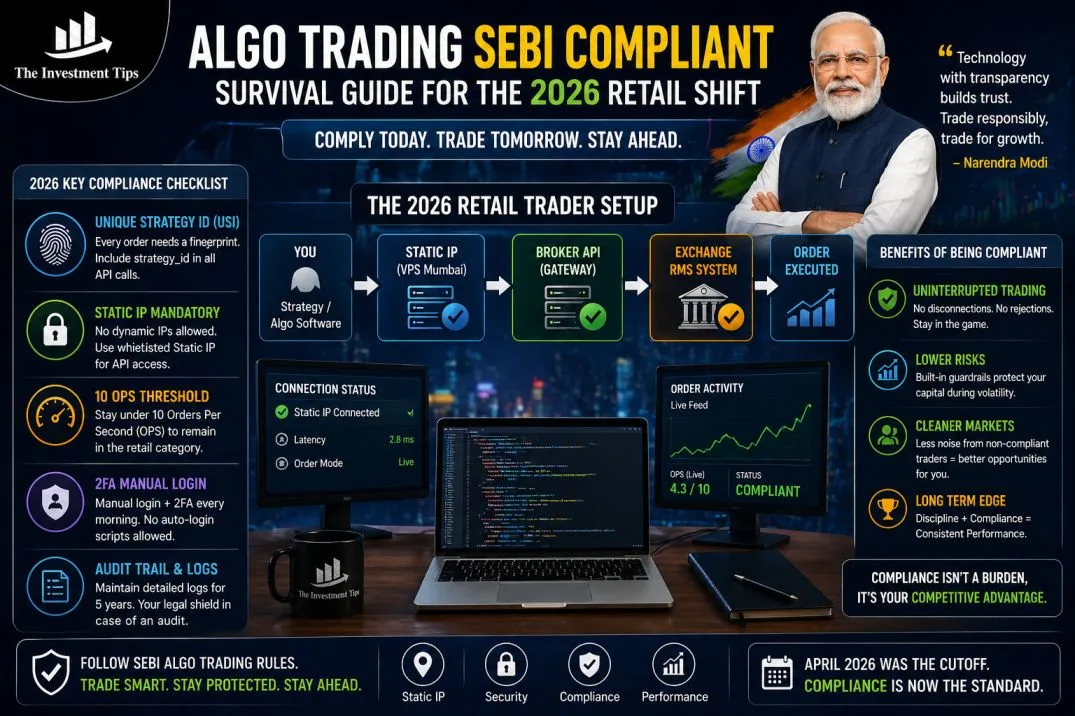
How does the broker know you're following the sebi algo trading rules? They use a validation layer. Before your order hits the exchange, the "Middleware" checks three things:
- IP Check: Is this the registered Static IP?
- Throttle Check: Is this guy spamming more than 10 OPS?
- Tag Check: Where is the Strategy_ID?
Fail any of these, and you’ll see a 403 Forbidden error. Successful 2026 traders build "Error Handling" to catch these rejections and stay in the game.
FAQ: The Quick & Dirty
Is algo trading legal for retail now? Yes. Always has been. Just make sure you use broker-issued APIs and follow the sebi algo trading rules.
Do Strategy IDs cost money? Standard ones are usually free from discount brokers. But high-speed or "exotic" strategies might have an exchange registration fee.
What's the best software for a newbie? Start with AlgoTest. It’s the easiest way to stay Algo Trading SEBI Compliant without needing a Computer Science degree.
Is it worth it for small accounts? Harder now. Between VPS costs, Static IPs, and API fees, accounts under ₹2L struggle to cover the "compliance tax."
The Audit Trail
In the 2026 trading environment, a "log" isn't just a text file on your hard drive; it is a forensic record of your compliance with federal mandates. Under the SEBI framework effective April 1, 2026, every automated order is treated with the same level of scrutiny as institutional trades.
Here is why your local data logs are your ultimate "legal shield":
1. The 5-Year Audit Trail Mandate
Brokers are now legally required to maintain detailed logs of all API and algorithmic activity for a minimum of 5 years. However, if a discrepancy arises between your broker's records and your actual execution, your personal logs serve as the primary counter-evidence.
- What to log: Exact order timestamps, the specific Unique Strategy ID attached to the trade, and the registered Static IP from which the request originated.
2. Proving "Static IP" Compliance
Because SEBI now mandates that all retail API orders must come from whitelisted static IP addresses, an exchange flag might occur if a packet appears to come from an unauthorized network.
- The Shield: Your local logs provide the "handshake" data showing that your system was indeed communicating from your registered IP, helping you dispute "unauthorized access" flags that could lead to account suspension.
3. Managing the 10 OPS Threshold
Retail traders staying under 10 Orders Per Second (OPS) are exempt from certain formal exchange registrations.
- The Risk: If the exchange's surveillance system incorrectly flags your strategy as "High-Frequency Trading" (HFT), you face heavy penalties and mandatory registration.
- The Shield: Your local logs act as a "throttle record," proving that your strategy remained within the legal retail limits at all times.
4. Verification of 2FA and OAuth Sessions
Since April 2026, all API sessions must be manually authenticated daily via OAuth 2.0 and 2FA.
- The Shield: Logging your daily authentication tokens and session start times proves that a "human-in-the-loop" was present and authorized the bot's activity, shielding you from claims of "unmonitored automated trading".
5. Protection Against "Black Box" Scrutiny
If you are using proprietary logic (a "Black Box" strategy), you are under higher transparency requirements.
- The Shield: Keeping detailed logs of the inputs and outputs (the signals and the resulting trades) ensures you can prove your strategy isn't manipulative or violating market-wide position limits during a regulatory audit.
The Reality Check: In a 2026 regulatory audit, the exchange won't take your word for it. They will look at the tagging and audit trails. If your local logs match the exchange's records, you’re safe. If you have no logs, you have no defense.
 in India.webp)