Do you worry about the stock market going up and down? Does bank volatility scare you? You are not alone. Millions of Indians still trust the post office. Why? Because it is backed by the government. It is simple. And the returns are guaranteed.
Right now, the post office saving account interest rate offers a safe harbor for your hard-earned money. Think of it as a financial anchor. It does not give you sleepless nights. Instead, it gives you peace of mind. In this blog, we will explore every small savings scheme. We will look at the Post Office FD interest rate and the Post Office Monthly Income Scheme. We will also check the Post Office 50,000 FD interest rate so you know exactly what to expect.
Post Office Saving Account Interest Rate Explained (2026)
Let us start with the most basic question. What is the post office saving account interest rate right now? As of early 2026, the government has kept the rate stable. For a regular savings account, you earn 4.0% per annum. This interest is calculated on your lowest balance between the 10th and the end of the month. The best part? You get this interest deposited every year. But you must file taxes on it if it exceeds a limit.
This rate is higher than many large private banks. Those banks offer just 2.5% to 3.5%. So, the post office wins here.
You may also read :- Best Post Office Saving Schemes in India 2026: Safe & High Returns Options
What is the Post Office Saving Account Interest Rate for Senior Citizens?
Here comes the real benefit. The post office saving account interest rate for senior citizens is slightly different. While the base rate is 4.0%, senior citizens get a small edge in other schemes. For the standard savings account, the rate is the same as others. However, if you move your money to a Post Office Monthly Income Scheme (POMIS), seniors enjoy better payouts.
Expert Opinion: Ramesh Gupta, a retired bank manager and financial advisor, says, "Seniors should not rely only on a savings account. They should combine it with the Monthly Income Scheme. That way, they get the 4% savings rate plus a higher monthly pension-like payout."
So, while the base savings rate is uniform, the government offers special benefits to seniors via other linked products.
Complete Post Office Interest Rates Table 2026 (All Schemes)
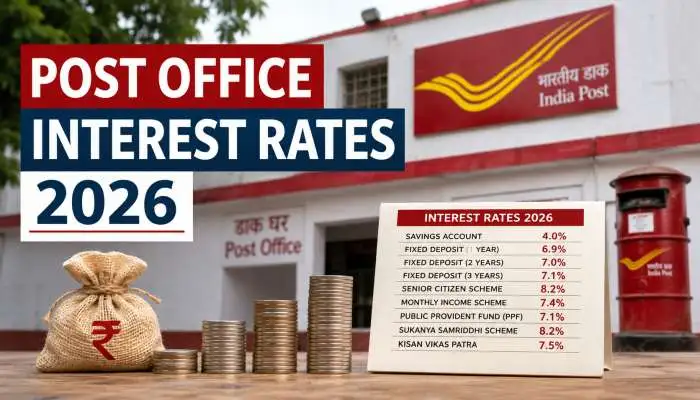
To make wise choices, you need the full picture. Below is the Post Office interest rates table 2026. Use this as your cheat sheet.
| Scheme Name | Interest Rate (2026) | Lock-in Period |
|---|---|---|
| Savings Account | 4.0% | None |
| 1-Year Time Deposit (FD) | 6.9% | 1 Year |
| 2-Year Time Deposit (FD) | 7.0% | 2 Years |
| 3-Year Time Deposit (FD) | 7.1% | 3 Years |
| 5-Year Time Deposit (FD) | 7.5% | 5 Years |
| Monthly Income Scheme (MIS) | 7.4% (Monthly payout) | 5 Years |
| Senior Citizens Savings Scheme (SCSS) | 8.2% | 5 Years |
| National Savings Certificate (NSC) | 7.7% | 5 Years |
| Kisan Vikas Patra (KVP) | 7.5% (114 months' maturity) | 114 months |
This Post Office interest rates table 2026 shows that long-term deposits give the highest returns. Keep this table bookmarked for future reference.
Understanding Post Office FD Interest Rate for 2026
Fixed deposits are the backbone of conservative investing. The Post Office FD interest rate is very attractive right now. Unlike banks, post office FDs are called "time deposits." You can open one for 1, 2, 3, or 5 years.
How Post Office FD Interest Rate Compares to Banks
Currently, the Post Office FD interest rate for a 5-year deposit is 7.5%. Most top banks offer only 6.5% to 7.0% for the same period. That 0.5% difference matters. On a ₹1 lakh deposit over 5 years, the post office gives you roughly ₹2,500 more than a bank.
Also, you get tax benefits under Section 80C for the 5-year FD. That is a double win.
Human Experience: Priya Sharma, a school teacher from Lucknow, shares, "I used to save in a bank. But when I saw the Post Office FD interest rate for 2026, I moved my emergency fund. The process was easy. The branch staff helped me fill the form. Now I earn 7.5% without any risk."
Deep Dive: Post Office Monthly Income Scheme (MIS)
Do you need a regular cash flow? The Post Office Monthly Income Scheme is your best friend. This scheme is designed for retirees, homemakers, or anyone who wants a fixed monthly check.
The current interest rate for MIS is 7.4% per annum. But here is the magic. The interest is paid monthly. You do not have to wait for one year. For every ₹1 lakh invested, you get roughly ₹616 every month.
Post Office 50,000 FD Interest Rate vs. Monthly Income
Many people ask about the Post Office 50,000 FD interest rate. Let us clarify. The post office does not have a special rate just for ₹50,000. The rate depends on the tenure. For a 1-year FD, the Post Office 50,000 FD interest rate is 6.9%. That means you earn ₹3,450 in one year.
But if you put that same ₹50,000 in the Post Office Monthly Income Scheme, you get around ₹308 every month. In one year, that totals ₹3,696. So, MIS gives you more cash in hand monthly.
| Investment | Scheme | Annual Interest |
|---|---|---|
| ₹50,000 | 1-Year FD | ₹3,450 |
| ₹50,000 | Monthly Income Scheme | ₹3,696 (Monthly payout) |
The choice depends on your need. Need monthly milk and grocery money? Pick MIS. Need a lump sum after one year? Pick FD.
New Interest Rates on Post Office Schemes for 2026
Every quarter, the government reviews the new interest rates on Post Office schemes. For the Jan-March 2026 quarter, the rates have been maintained. This stability is good news. However, there is a trend. The new interest rates on Post Office schemes show a slight increase compared to 2024. Back then, the 5-year FD was 7.2%. Now it is 7.5%. The savings account used to be 3.5%. Now it is 4.0%.
Official Statement: The Finance Ministry’s recent circular stated, "The new interest rates on Post Office schemes are aligned with government bond yields to ensure small savers get fair returns."
So, if you have been waiting for rates to rise, now is the time to act.
How to Calculate Your Earnings (Real Examples)
Numbers can be boring. Let us make them real. We will take three common scenarios.
Scenario A: Post Office Saving Account Interest Rate for a Family
Mr. and Mrs. Verma keep ₹2 lakhs in their joint savings account. The post office saving account interest rate is 4.0%. Their lowest balance is usually ₹1.5 lakhs. So, they earn ₹6,000 per year. That is free money for just keeping cash in a safe place.
Scenario B: Using Post Office FD Interest Rate for a Child’s Future
Mrs. Nair wants to save for her daughter’s college in 5 years. She puts ₹1 lakh in a 5-year FD. Using the Post Office FD interest rate of 7.5%, her maturity amount is ₹143,500. Plus, she saves tax under 80C. That is smart planning.
Scenario C: Post Office 50,000 FD Interest Rate for Emergency Fund
Mr. Khan has ₹50,000 as an emergency fund. He puts it in a 1-year FD. The Post Office 50,000 FD interest rate is 6.9%. He earns ₹3,450 in one year. If an emergency comes, he can break the FD with a small penalty. But mostly, his money grows safely.
Senior Citizens Corner: Maximizing Benefits

If you are a senior, listen closely. The post office saving account interest rate for senior citizens is just the start. You should not stop there.
Combining Savings with Senior Citizens Savings Scheme (SCSS)
The SCSS offers 8.2% interest. That is more than double the savings account rate. You can invest up to ₹30 lakhs. And you get quarterly interest payouts. So, use your savings account to park cash. Then move bulk money to SCSS or MIS.
Expert Quote: Dr. Alok Verma (Economic Analyst) advises, "For seniors, the post office savings account interest rate for senior citizens is good for liquidity. But wealth creation happens in SCSS and MIS. Always keep 20% in savings for emergencies. Put 80% in SCSS for high income."
Also, remember that post office savings accounts offer a nomination facility. Always add a nominee. It makes the process easy for your family.
Step-by-Step Guide to Open an Account (2026 Process)
Opening an account is easier than ever. You do not need to be a tech wizard.
Step 1: Visit your nearest post office. Look for the "Small Savings" counter.
Step 2: Ask for Form SB-3 (for savings account) or Form A (for FD/MIS).
Step 3: Fill the form. Write clearly. Use black ink.
Step 4: Attach photos. Carry your Aadhaar and PAN card.
Step 5: Deposit cash or check. For the Post Office 50,000 FD interest rate application, you need to specify the tenure.
Step 6: Get your passbook. It is your proof.
Important: You can also open an account through India Post’s online portal if you have internet banking activated. But for first-timers, visiting the branch is better. The staff is usually very helpful.
Pros and Cons of Post Office Savings (Honest Review)
Nothing is perfect. Let us be fair.
Pros:
- Safety: Government-backed. Zero risk.
- Rates: Higher than most banks for post office savings account interest rates.
- Access: Over 1.5 lakh post offices in India.
- Flexibility: Small deposits allowed (minimum ₹500).
Cons:
- Inconvenience: Sometimes branches are crowded.
- Technology: The app is not as fast as private banks.
- Lock-in: MIS and FDs have lock-ins. You cannot withdraw anytime.
Despite the cons, for a risk-free investor, the Post Office FD interest rate and savings rate are unbeatable.
Conclusion: Your Money, Your Choice
You now have the complete map. The post office saving account interest rate of 4.0% is a great start for your savings journey. It is safe, simple, and sovereign.
Look at the Post Office interest rates table 2026 again. See the Post Office FD interest rate for long goals. Think about the Post Office Monthly Income Scheme for regular expenses. Check the Post Office 50,000 FD interest rate for medium-term needs.
Most importantly, seniors have a clear path. Use the post office saving account interest rate for senior citizens as a base. Then move to higher-yielding schemes.
Don't let your money sit idle. Inflation is a silent thief. But with the new interest rates on Post Office schemes in 2026, you have a powerful shield. Visit your local post office today. Open that account. Watch your savings grow. It is your turn to build a stress-free financial future.
Frequently Asked Questions
Q1: Is the post office saving account interest rate changed every year?
No, the government reviews it every quarter. However, in 2026, the rate has remained stable at 4.0% for the first quarter. Always check the latest Post Office interest rates table 2026 on India Post’s official site.
Q2: Can a minor get the post office saving account interest rate for senior citizens?
No. The higher benefits are only for individuals aged 60 years or above. Minors get the same 4% base rate as adults.
Q3: What is the Post Office 50,000 FD interest rate for 5 years?
The rate is 7.5% for a 5-year FD. So, on ₹50,000, you will earn approximately ₹21,750 in total interest over 5 years. That is a solid return.
Q4: Is the Post Office Monthly Income Scheme taxable?
Yes. The interest you earn from the Post Office Monthly Income Scheme is fully taxable as per your income tax slab. However, no TDS is deducted if you file Form 15G/15H.
Q5: Which is better: Bank FD or Post Office FD interest rate?
Currently, the Post Office FD interest rate (7.5% for 5 years) is better than most large banks (max 7.0%). Only some small finance banks offer higher rates, but they carry more risk.
 in India.webp)