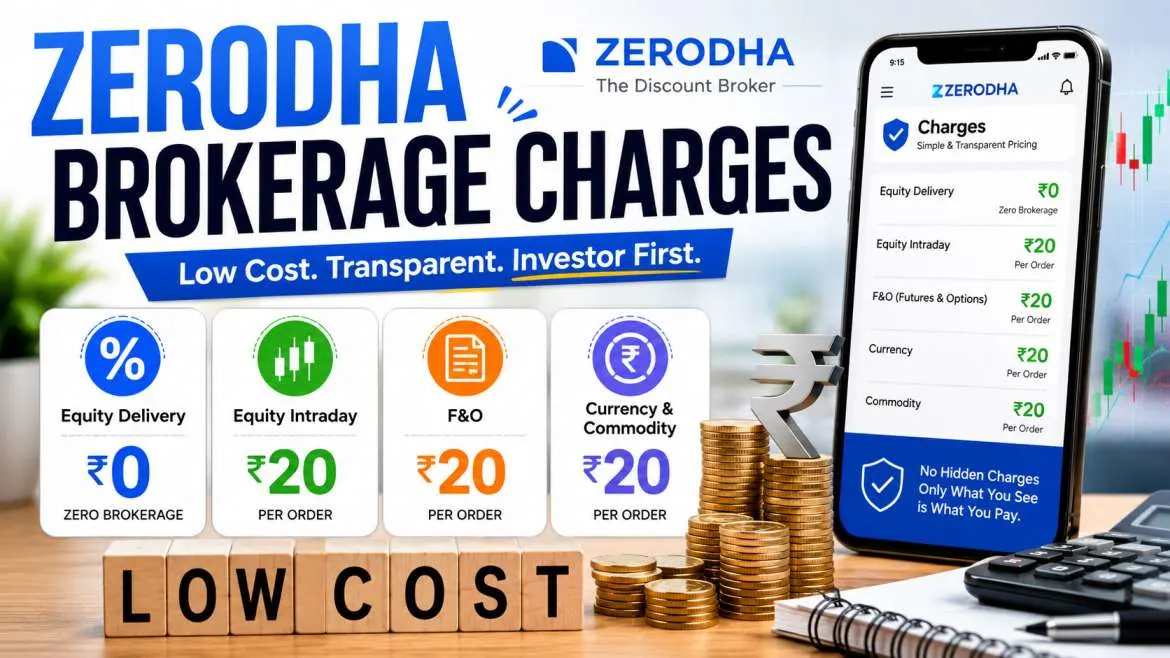
Zerodha brokerage charges are straightforward: equity delivery investments are completely free, while intraday and futures trades cost either ₹20 or 0.03% per trade (whichever happens to be lower). If you're trading options, it’s a flat ₹20 per order. Because of this pricing, they’ve become one of the go-to discount brokers in India.
Keep in mind that your final bill isn't just the flat brokerage fee; it also includes government and regulatory extras like STT, exchange transaction fees, GST, and SEBI charges. Knowing how these add up is key to protecting your profit margins. To avoid any surprises, it's always a good idea to run your numbers through a brokerage calculator before you pull the trigger on a trade.
Understanding Zerodha Brokerage Charges Structure

Unlike traditional brokers who charge a percentage of trade value, Zerodha follows a discount model. They keep fees low and transparent. Here's why traders love this approach:
- No hidden costs – All charges are clearly listed
- Flat fee structure – No surprise bills at month-end
- Affordable for all – Works well for small and big traders
The platform grew popular because it made trading cheap. Before Zerodha, brokers charged 0.5% or more per trade. Today, Zerodha offers the same service at a fraction of that cost .
You may also read :- Stock Brokerage Charges Explained: Hidden Fees Revealed
Zerodha Brokerage Charges for Different Segments
Zerodha charges vary based on what you trade. Let's break it down:
Equity Delivery Trades – Completely Free
Zerodha brokerage charges for equity delivery are ₹0. You pay no brokerage when you buy and hold shares . This is perfect for long-term investors. However, you still pay:
- STT (Securities Transaction Tax)
- Exchange transaction charges
- GST on other charges
- SEBI fees
Even with these fees, delivery trading stays very affordable.
Zerodha Brokerage Charges for Intraday
Zerodha brokerage charges for intraday follow a simple rule: ₹20 or 0.03% of trade value, whichever is lower . For example:
- If you trade ₹50,000, 0.03% equals ₹15. So you pay ₹15
- If you trade ₹1,00,000, 0.03% equals ₹30. So you pay ₹20 (capped)
This structure benefits both small and large traders. Small trades pay less than ₹20, while large trades get the cap benefit.
Zerodha Brokerage Charges for F&O
Zerodha brokerage charges for F&O are different for futures and options:
Futures trades: ₹20 or 0.03% (whichever is lower) Options trades: Flat ₹20 per executed order
F&O traders also pay STT, exchange fees, and other statutory charges. Zerodha brokerage charges for F&O remain among the lowest in the industry.
Zerodha Brokerage Charges for Stocks
Zerodha brokerage charges for stocks depend on the segment:
| Segment | Brokerage Fee |
|---|---|
| Delivery | ₹0 (free) |
| Intraday | ₹20 or 0.03% (lower) |
| Futures | ₹20 or 0.03% (lower) |
| Options | ₹20 flat per order |
What Are the Statutory Charges?
Brokerage is just one cost. Several mandatory charges apply to every trade:
Securities Transaction Tax (STT)
STT is a government tax. Rates vary by segment:
- Delivery: 0.1% on both buy and sell
- Intraday: 0.025% on sell side only
- Futures: 0.05% on sell side
- Options: 0.15% on sell side (on premium)
Exchange Transaction Charges
Exchanges charge a fee for every trade. These are:
- NSE equity: 0.00307%
- BSE equity: 0.00375%
- NSE futures: 0.00183%
- NSE options: 0.03553% on premium
GST, SEBI Charges, and Stamp Duty
- GST: 18% on (brokerage + SEBI charges + exchange charges)
- SEBI charges: ₹10 per crore of turnover
- Stamp duty: Varies by state and segment
Zerodha Brokerage Charges Calculator – Know Your Exact Cost
How to Use the Zerodha Brokerage Calculator
Zerodha provides an official brokerage calculator on their website . It helps you:
- Estimate total charges before trading
- Compare different trade sizes and segments
- Calculate net profit after all fees
Steps to use the calculator:
- Visit Zerodha's brokerage calculator page
- Select the segment (Equity, F&O, Currency, Commodity)
- Enter buy price, sell price, and quantity
- View breakdown of all charges
Several third-party tools also offer similar functionality, including Chrome extensions and Python packages .
Understanding Calculator Results
The calculator shows:
- Brokerage: Your trading fee
- STT: Government tax
- Exchange charges: Fees paid to NSE/BSE
- GST: Tax on services
- SEBI charges: Regulatory fee
- Stamp duty: State government levy
- DP charges: Demat account fees for delivery
- Total charges: Sum of all costs
- Net profit: Profit after all charges
Example Calculation for Intraday Trade
Let's say you trade 400 shares at ₹1000 buy and ₹1100 sell :
- Turnover: ₹4,40,000
- Brokerage: ₹20 (capped)
- STT: ₹110 (0.025% on sell)
- Exchange charges: ~₹13.5
- GST: ~₹6
- Total charges: ~₹150
- Net profit: ~₹39,850
This shows how small fees can add up. The calculator helps you plan accordingly.
Groww vs Zerodha Brokerage Charges: Which Is Better?
Direct Comparison of Fees
Groww vs Zerodha brokerage charges differ in several ways:
| Feature | Zerodha | Groww |
|---|---|---|
| Equity Delivery | ₹0 free | ₹20 or 0.1% (lower) |
| Equity Intraday | ₹20 or 0.03% (lower) | ₹20 or 0.1% (lower) |
| Futures | ₹20 or 0.03% (lower) | ₹20 flat |
| Options | ₹20 flat | ₹20 flat |
| AMC (Demat) | ₹300/year | ₹0 free |
| Account Opening | ₹200 | ₹0 free |
| DP Charges | ~₹15.9 + GST | ~₹21.8 + GST |
Which Broker Should You Choose?
Choose Zerodha if: - You invest in delivery stocks (free brokerage) - You trade actively in F&O - You prefer a robust platform (Kite) - You need advanced trading tools
Choose Groww if: - You are a new investor - You want zero AMC - You prefer a simple mobile app - You do smaller trades
In a sample delivery trade of ₹4 lakh, Zerodha saved ₹53 in total charges compared to Groww . However, Groww's zero AMC could save long-term investors ₹300 yearly.
Hidden Costs and Special Charges You Must Know
Account Opening and Maintenance Fees
- Individual account: Free opening
- First year AMC: Free
- Demat AMC (2nd year): ₹300 or free for holdings under ₹4 lakh (BSDA)
- NRI account opening: ₹500
- HUF/Corporate/Partnership: ₹500 (offline)
Call & Trade Charges
If you call Zerodha to place a trade, they charge ₹50 per order . This includes auto square-off orders. Avoid this by using the Kite app for free.
DP Charges and Pledging Fees
- DP charges: ₹15.34 per scrip (₹3.5 CDSL + ₹9.5 Zerodha + GST) on delivery sells
- Pledging charges: ₹30 + GST per request
- MTF (Margin Trading Facility): 0.04% daily interest on funded amount
Special Cases – When Brokerage Doubles to ₹40
Starting April 1, 2026, Zerodha charges ₹40 per F&O order for traders who don't meet SEBI's 50% cash collateral rule . This applies when:
- Your account has a cash shortfall over ₹5 lakh
- You trade using collateral without enough cash
- You fail to maintain 50% cash margin
Regular traders with sufficient cash still pay ₹20 . This change affects less than 1% of users.
NRI and Society Account Charges
NRI charges: - Non-PIS account: 0.5% or ₹50 per order - PIS account: 0.5% or ₹200 per order - AMC: ₹500 + GST yearly
Society/Company accounts: - Delivery: ₹20 or 0.1% (lower) - Intraday/Futures: ₹20 or 0.03% (lower) - Options: ₹20 flat
How to Minimize Your Trading Costs?
Smart Strategies for Cost Reduction
1. Use the Zerodha brokerage calculator Always check total charges before placing a trade. The Zerodha brokerage charges calculator helps you avoid surprises.
2. Choose delivery for long-term holdings Since delivery is free, hold stocks for longer periods. This saves brokerage compared to frequent intraday trading.
3. Maintain sufficient cash balance Avoid the ₹40 brokerage by keeping 50% cash margin. This keeps you in the regular ₹20 bracket.
4. Avoid call & trade Place orders through Kite to save ₹50 per order. Never call the dealer unless absolutely necessary.
5. Opt for BSDA demat If your holdings are under ₹4 lakh, you pay zero AMC. This saves ₹300 yearly.
Comparing Total Costs Across Segments
Use the brokerage calculator to compare:
- Intraday vs delivery costs – Delivery may be cheaper for long-term
- Different trade sizes – Larger trades benefit from the cap
- Multiple brokers – Compare Groww vs Zerodha for your specific trade
Real-World Examples and Case Studies
Example 1: Long-Term Investor
- Scenario: An investor purchases equity shares valued at ₹5,00,000 to hold in a demat account for several years.
- Brokerage Fee: This transaction incurs ₹0 in platform brokerage since it qualifies as a standard equity delivery investment.
- Total Execution Cost: The investor pays only statutory government fees, including Securities Transaction Tax (STT), stamp duty, and exchange fees, totaling approximately ₹1,000.
- Operational Verdict: This remains an exceptionally cost-effective model for wealth creation over long horizons.
Example 2: Active Intraday Trader
- Scenario: A day trader executes 10 separate intraday transactions daily, with each individual trade volume averaging ₹50,000.
- Brokerage Fee Per Trade: The fee defaults to ₹15 per executed order because 0.03% of the ₹50,000 transaction value is lower than the standard ₹20 cap.
- Cumulative Daily Cost: The baseline platform brokerage totals ₹150 across all 10 completed market executions.
- Estimated Monthly Expense: Assuming 20 active trading sessions per month, the base platform commission scales to approximately ₹3,000.
- Operational Verdict: The fractional percentage model keeps daily scalping fees highly manageable for retail participants.
Example 3: F&O Options Trader
- Scenario: An active derivative specialist places 5 distinct options contract transactions during a single session.
- Brokerage Fee Per Trade: Every individual trade incurs a predictable flat rate of ₹20 per executed order.
- Cumulative Daily Cost: The daily base platform commission scales out to exactly ₹100 for the 5 completed contract orders.
- Estimated Monthly Expense: Calculated across 20 standard monthly sessions, the regular trading commission amounts to roughly ₹2,000.
- Operational Verdict: The flat-fee structure offers significant cost advantages over legacy firms that use percentage-based charging models.
Expert Opinion
Nithin Kamath, Zerodha's CEO, emphasizes transparency in pricing. He states, "We keep charges simple so traders know exactly what they pay" . However, he warns that regulatory changes may force future price adjustments . This underscores the importance of staying updated on fee changes.
Conclusion: Is Zerodha the Right Choice for You?
Zerodha brokerage charges offer excellent value for most traders. The free delivery makes it unbeatable for long-term investors. Intraday and F&O traders benefit from the low flat fees. The transparent pricing structure helps you know exactly what you pay.
However, consider your trading style:
- Long-term investors: Zerodha is the cheapest (free delivery)
- Active intraday traders: Very cost-effective (₹20 cap)
- F&O traders: Competitive rates (₹20 flat)
- Beginners: Consider Groww if you want zero AMC and simple app
Always use the Zerodha brokerage charges calculator to estimate costs. Stay updated on fee changes from regulatory updates. With careful planning, Zerodha helps you keep more profits in your pocket.
Start your trading journey with Zerodha today. Use their calculator, understand the fees, and trade smart. Remember, knowledge of charges is the first step to profitable trading. Happy investing!
Frequently Asked Questions
What are Zerodha brokerage charges for equity delivery?
Zerodha brokerage charges for equity delivery are ₹0. You pay zero brokerage when buying and holding stocks. However, statutory charges like STT, exchange fees, GST, and SEBI charges still apply .
How does the Zerodha brokerage charges calculator work?
The Zerodha brokerage charges calculator estimates total costs before you trade. You enter buy price, sell price, quantity, and segment. The calculator shows brokerage, statutory charges, and net profit. It helps plan trades effectively .
What is the difference between Groww and Zerodha brokerage charges?
Zerodha offers free equity delivery but charges a ₹300 yearly maintenance fee, whereas Groww has zero maintenance fees but charges up to ₹20 per delivery trade.
Are Zerodha brokerage charges for intraday different from delivery?
Yes. Zerodha brokerage charges for intraday are ₹20 or 0.03% (lower) per order. Delivery trading is completely free . Intraday also has lower STT (0.025% on sell) compared to delivery (0.1% both sides).
What are Zerodha brokerage charges for F&O trades?
Zerodha brokerage charges for F&O are ₹20 or 0.03% (lower) for futures and ₹20 flat for options . Additional costs include STT, exchange fees, GST, and SEBI charges. Some traders may pay ₹40 per order if they don't maintain 50% cash collateral .
Does Zerodha charge AMC fees?
Yes, after the first year. The demat AMC is ₹300 + 18% GST yearly for holdings above ₹4 lakh . If your holdings are under ₹4 lakh, the account is a BSDA account with zero AMC. Groww offers zero AMC for all users .
 in India.webp)