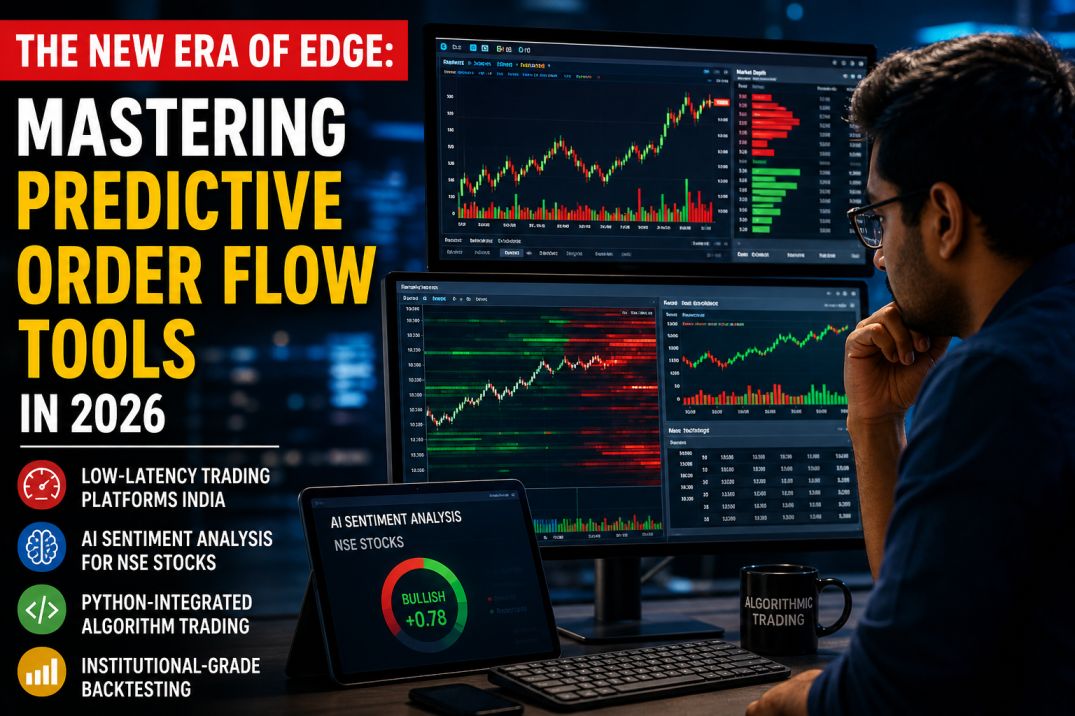
The retail trading landscape just got a massive upgrade. Forget lagging RSI indicators or basic moving averages that everyone and their neighbor can see. In the high-stakes world of May 2026, the real money is being made by those who look at what’s happening inside the exchange before the price even moves.
We are talking about Predictive Order Flow Tools, a specialized tech stack that was once the exclusive playground of high-frequency trading (HFT) firms in Mumbai’s BKC or New York’s Wall Street. Now? It’s sitting right on your dashboard.
Key Takeaways
- The Shift: Successful trading in 2026 has moved from "Price Action" to "Volume Analysis" and "Order Imbalance."
- The Tech: Success hinges on choosing the Best Low-Latency Trading Platforms India to ensure your orders hit the matching engine before the crowd.
- The Edge: Retail traders are now leveraging AI Sentiment Analysis for NSE Stocks to predict volatility spikes before the news even hits the mainstream wires.
The Mechanics of the "Tape": Why Order Flow is King
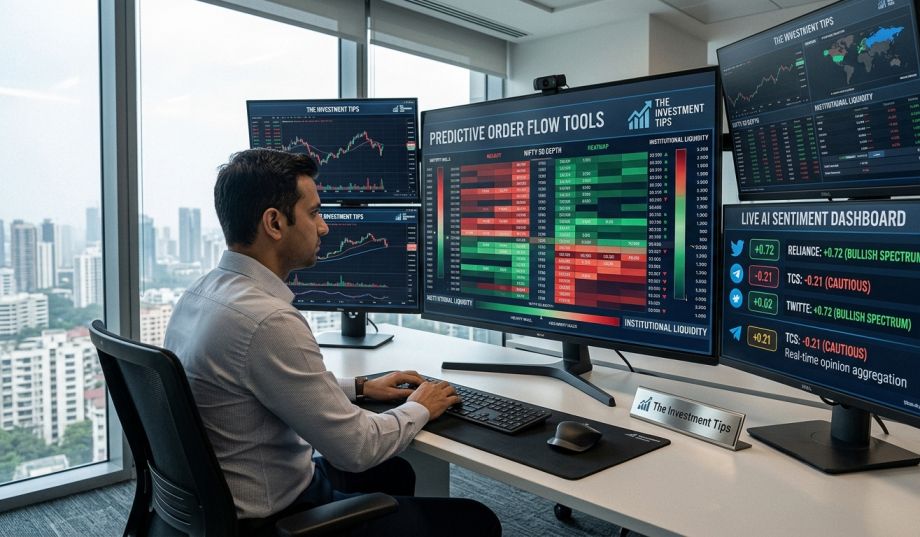
Why are we moving away from traditional charts? Simple. Charts tell you where the price was. Order flow tells you where the price is going. By analyzing the "limit order book"—the list of buy and sell orders waiting to be executed—we can see the "walls" of liquidity that big institutional players are setting up.
You may also read :- Best Zero Brokerage F&O Apps in India
The Liquidity Hunt
Institutional players don't trade like us. They don't just "click buy." They use icebergs and hidden orders to hide their tracks. Predictive Order Flow Tools act like an X-ray machine, revealing these hidden footprints. If you see a massive sell wall at a specific Nifty level that keeps getting "refilled," you aren't just looking at resistance. You’re looking at an institution liquidating a position.
Pro-Tip: The "Delta" Secret
Don't just watch the volume; watch the Cumulative Delta. This measures the difference between aggressive buyers and aggressive sellers. If price is falling but Delta is rising, you’ve found a "Bullish Divergence" that traditional indicators will miss 9 times out of 10.
Speed as a Moat: Finding the Best Low-Latency Trading Platforms India
In search arbitrage and high-speed scalping, a millisecond is the difference between a "Green Day" and a "System Error." Choosing from the Best Low-Latency Trading Platforms India is no longer optional; it’s a mechanical necessity.
Case Study: The 2026 Union Budget Flash-Crash
During the recent budget volatility, traders using standard discount brokers faced "order freezes" and 2-second execution lags. Meanwhile, those on high-performance platforms with co-located servers (servers sitting right next to the NSE exchange) executed trades in under 50 milliseconds. They caught the "wick" while everyone else was stuck on a loading screen.
- Hot Take: Most traders blame their "strategy" for a loss. Usually, it's just poor execution hardware. If your broker doesn't offer a dedicated API with a direct line to the exchange, you aren't a trader—you're a victim.
- Under-the-Hood: Look for brokers that support FIX Protocol or have native Python-Integrated Brokerages for Algorithmic Trading. These allow your code to talk directly to the market without the "bloat" of a heavy web interface.
Social Intelligence: AI Sentiment Analysis for NSE Stocks
The news moves markets, but the anticipation of news moves them faster. In 2026, we use AI Sentiment Analysis for NSE Stocks to monitor the collective "mood" of the market across X (formerly Twitter), Telegram, and financial forums.
The "Crowd" vs. The "Capital"
When we see a sudden spike in "Bullish Sentiment" on social media but the Cumulative Delta (Order Flow) shows big players are selling, we know a "Liquidity Trap" is being set.
- Real-World Scenario: A mid-cap pharma stock starts trending on WhatsApp groups. Retailers pile in. Our sentiment tools show "Extreme Greed." Simultaneously, our Predictive Order Flow Tools show massive "Iceberg" sell orders at the top. We short. The retail crowd gets trapped. We profit.
- Technical Detail: Modern sentiment engines use Natural Language Processing (NLP) to distinguish between a "sarcastic" tweet and a "serious" financial update. They filter out the noise and give you a numerical "Bias Score" from -1 to +1.
The Scientific Approach: Institutional-Grade Backtesting Tools for Retail
You wouldn't launch a rocket without a simulation. Why launch a trade without one? Institutional-Grade Backtesting Tools for Retail have replaced the old "paper trading" methods.
Deep-Data Backtesting
We are no longer just checking if a strategy worked on "Close Prices." We are testing it against "Tick Data"—every single trade that happened over the last decade.
- Hot Take: If your backtest doesn't account for "Slippage" and "Brokerage Taxes," it's a fairy tale. Most strategies look great on a 1-minute chart but fail in real life because they ignore the cost of doing business.
- Under-the-Hood: Use tools that allow for Monte Carlo Simulations. This runs your strategy through 1,000 "What If" scenarios (varying market conditions, sudden crashes, low liquidity) to see if your account would survive a "Black Swan" event.
Pro-Tip: The Python Advantage
If you aren't using Python-Integrated Brokerages for Algorithmic Trading, you are manually doing work that a script could do better. Even a simple script that automatically moves your Stop-Loss to "Break Even" after a 1% gain can save you lakhs in emotional errors over a year.
Automation and APIs: Python-Integrated Brokerages for Algorithmic Trading
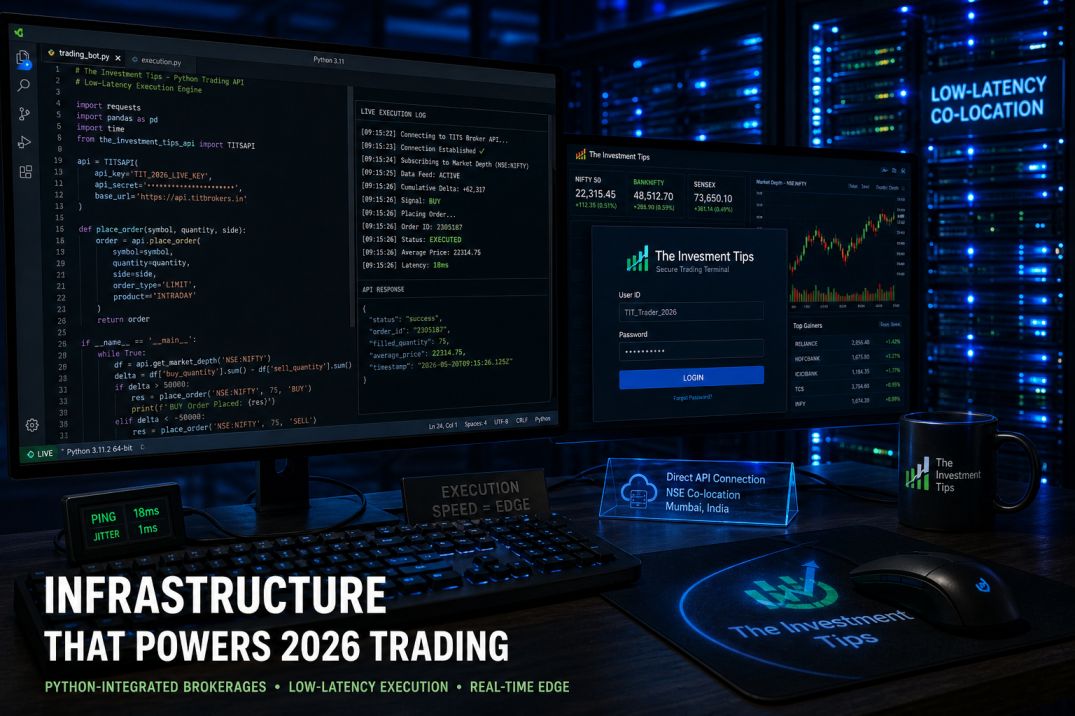
The days of staring at screens for 6 hours are over. The modern professional uses Python-Integrated Brokerages for Algorithmic Trading to automate the "boring" parts of the job.
The "No-Code" Bridge
Even if you aren't a coder, 2026 has brought "No-Code" bridges that convert your visual logic into Python scripts.
- Real-World Scenario: You want to buy the Nifty Bank every time the "Order Flow Delta" crosses +50,000. You set the logic once. You go have lunch. Your Python script monitors the NSE tick-feed, executes the trade, and sends a notification to your phone when the target is hit.
- Technical Detail: This relies on WebSockets. Instead of your computer "asking" the broker for the price every second (polling), the broker "pushes" the price to you the millisecond it changes. It’s the difference between a letter and a live phone call.
The Verdict: Is Order Flow a "Holy Grail"?
Let’s be honest. There is no Holy Grail. Predictive Order Flow Tools are a massive advantage, but they aren't a magic button. It works. Until it doesn't.
The "Linguistic Friction" of the market in 2026 is that as more retail traders gain these tools, the "Edge" becomes thinner.
- The "Burstiness" of the Tape: Markets can go from "Perfect Orderly Flow" to "Absolute Chaos" in three seconds. If a major global event happens, the "limit orders" disappear, and the tape goes blank.
- Peer-to-Peer Advice: Don't bet the house on a single indicator. Use sentiment to find the "Why," use order flow to find the "When," and use low-latency execution to ensure you actually get the price you saw.
Your 2026 Trading Tech Stack
To succeed in the current Indian market, your stack should look like this:
- Execution: One of the Best Low-Latency Trading Platforms India with API access.
- Analysis: A dedicated suite of Predictive Order Flow Tools (like Bookmap or GoCharting).
- Strategy: A Python-based system for Institutional-Grade Backtesting Tools for Retail.
The market doesn't care about your feelings; it only cares about liquidity. Follow the big money, watch the tape, and automate the execution.
Frequently Asked Questions (FAQ)
What are Predictive Order Flow Tools exactly?
They are software suites that analyze the "Market Depth" and "Trade Prints" (Time & Sales) to identify where big institutions are placing their orders before the price moves.
Why should I care about AI Sentiment Analysis for NSE Stocks?
In 2026, social media sentiment often leads price action. If everyone is talking about a stock but nobody is buying it on the tape, it’s a clear signal of a potential "Pump and Dump."
How do I find the Best Low-Latency Trading Platforms India?
Look for brokers that offer "Direct Market Access" (DMA) and have servers located in the same data centers as the NSE/BSE.
Can a retail trader use Python-Integrated Brokerages for Algorithmic Trading?
Yes. Most modern Indian brokers now provide free API keys to retail users, allowing you to connect Python libraries like Pandas and NumPy directly to your trading account.
Is Institutional-Grade Backtesting Tools for Retail expensive?
Not anymore. What used to cost ₹50,000 a month is now available for a fraction of that through "SaaS" platforms that offer cloud-based historical tick data.
 in India.webp)