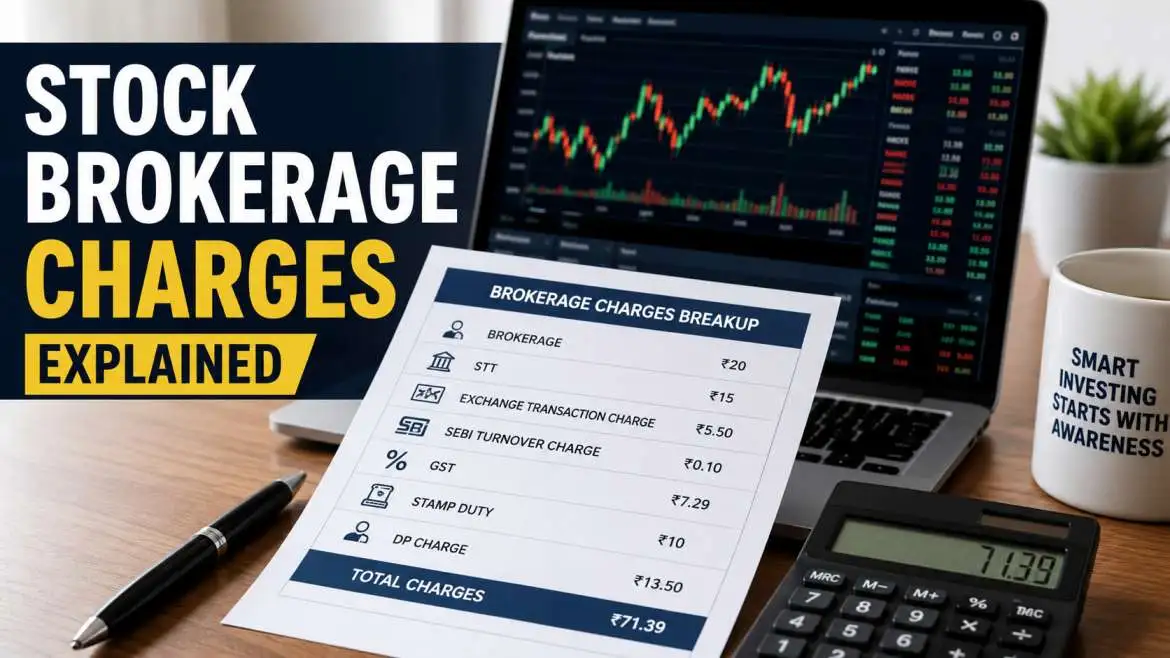
These are fees you pay to your broker when you buy or sell shares. Think of it like a service charge for using their platform to trade. In India, these charges are not just one fee. They include many parts like the broker's commission, government taxes, and exchange fees.
Knowing these costs is key to keeping more of your hard-earned money. When you understand stock brokerage charges explained, you can choose the right broker and boost your trading profits. This guide will break it down in easy steps.
What Are Brokerage Charges in the Stock Market?
Whenever you trade shares, your broker charges a fee. This is the main cost of trading. These charges are how brokers make money for their services. The amount you pay depends on your broker's model. It can be a percentage of your trade value or a flat fee per order .
SEBI, India's market regulator, sets a maximum limit. A broker cannot charge more than 2.5% of the total transaction value as their fee . However, actual charges are usually much lower due to competition.
You may also read :- Top 10 Discount Brokers in India with Lowest Charges
How Stock Brokerage Charges Explained Works in India?

Types of Brokers and Their Charges
Full-Service Brokers: These brokers offer complete services. They give you research reports, investment advice, and a relationship manager. Because they offer more help, their fees are higher. They usually charge a percentage of your trade value, typically between 0.01% and 0.50% .
Discount Brokers: These brokers focus on providing a trading platform. They do not offer personalized advice. Their main advantage is low cost. They usually charge a flat fee per trade, like ₹20 per order. This model is great for traders who do their own research .
Percentage-Based Brokerage Model
In this model, you pay a percentage of the total trade value. For example, if a broker charges 0.05% and you buy shares worth ₹3,10,000, you pay ₹155 as brokerage . This model is common with full-service brokers. For example, a percentage-based fee model is often used for delivery trades .
Flat Fee Brokerage Model
Discount brokers popularized this model. You pay a fixed amount for each trade, no matter the size. For example, if the broker charges ₹20 per order, you pay ₹20 regardless of whether you trade ₹10,000 or ₹10,00,000 . This is very beneficial for large trades. The stock brokerage charges explained for a flat fee model is simple and predictable.
Subscription-Based Model
Some newer brokers use a subscription model. You pay a fixed fee monthly or yearly. In return, you get free trades or reduced costs . For example, platforms like m.Stock offer a Zero Brokerage plan for a one-time fee, making trading completely free afterward .
Taxes and Other Charges Beyond Brokerage
The fee your broker charges is just one part. Several other charges add to your total trading cost. Stock brokerage charges explained must include these additional costs to give you a complete picture.
Securities Transaction Tax (STT)
This is a tax the government levies on stock market transactions. It is a significant cost. For equity delivery, STT is 0.1% on both buy and sell sides. For intraday equity trades, it is 0.025% on the sell side only .
GST on Brokerage and Other Fees
You pay 18% GST on the brokerage fee. This tax also applies to transaction charges and SEBI fees .
Exchange Transaction Charges
Stock exchanges like NSE and BSE charge a fee for facilitating your trade. This rate varies. For example, NSE charges 0.00307% for equity delivery transactions .
SEBI Turnover Fees
SEBI charges a small fee of ₹10 per crore of your turnover .
Stamp Duty
This is a state government tax. It is charged only on the buy side of a trade. The rate can vary depending on your state .
DP Charges
When you sell shares, your broker charges a depository fee. This is for taking the shares out of your demat account. It is usually around ₹15.34 per scrip, including GST .
How to Calculate Your Total Trading Cost?
To calculate the total cost, add the brokerage fee to all the other charges. Here's a simple breakdown.
For an Intraday Trade Example:
- You buy and sell shares worth ₹1,00,000.
- Brokerage: ₹20 (flat fee)
- STT (Sell side): ₹25 (0.025% of ₹1,00,000)
- Transaction Charge: ₹30.7 (approx 0.00307%)
- GST: ₹10.8 (18% of ₹60)
- Total Cost: ₹86.5
This shows the stock brokerage charges explained calculation goes beyond just the broker's fee. Including the STT, the total cost becomes significant. Using a brokerage calculator can help you estimate these costs accurately .
Read more:- How to Compare Online Brokerages and Choose the Best Trading App
Stock Brokerage Charges Explained Zerodha

Zerodha is a pioneer in discount broking in India. Their stock brokerage charges explained are straightforward. They offer a transparent and low-cost model.
Zerodha's Brokerage Structure
- Equity Delivery: ₹0 brokerage. It is completely free .
- Equity Intraday: ₹20 per executed order or 0.03% of the turnover, whichever is lower .
- Futures: ₹20 per executed order or 0.03% of the turnover, whichever is lower .
- Options: ₹20 per executed order.
Zerodha provides a clear breakdown of all charges on their website. This transparency is a major reason for their popularity. Stock brokerage charges explained Zerodha helps traders know exactly what they will pay per trade.
Stock Brokerage Charges Explained India
Stock brokerage charges explained India means understanding the models available in the Indian market. The competition among brokers has made trading cheaper for retail investors.
m.Stock Brokerage Charges
m.Stock is another popular discount broker. They offer unique plans.
- Zero Brokerage Plan: For a one-time fee of ₹999, you get zero brokerage for life on all products .
- ₹149 Plan: In this plan, equity delivery, mutual funds, IPOs, and ETFs are free. A flat ₹20 per order is charged on intraday, futures, and options .
This shows how the Indian market offers several cost-saving options .
Factors That Affect Your Brokerage Charges
Several factors determine your total brokerage cost. Understanding them helps you make better decisions. Stock brokerage charges explained needs to cover these influencing elements.
Type of Trade
The cost differs based on the trade type. Delivery trades often have a different structure than intraday trades. Intraday trading usually has higher risk and different brokerage models .
Trading Volume
With percentage-based brokers, higher volume means higher costs. But many discount brokers offer flat fees, which are better for high-volume traders .
Type of Asset
Brokerage varies for different assets. Equity, futures, options, and currencies all have different charge structures .
How to Reduce Your Brokerage Costs?
Lower costs mean higher profits. Here are some ways to reduce your brokerage expenses.
Choose the Right Broker
If you are an active trader, a discount broker with a flat fee is best. If you need advice and are a long-term investor, a full-service broker might be better despite higher fees .
Use a Brokerage Calculator
Always use a brokerage calculator before a trade. This helps you see the total cost and the net profit. It's a crucial tool for informed trading .
Know the Charges
Understand the complete cost structure. Knowing about STT, GST, and transaction charges helps you calculate your true breakeven point. This is a key part of stock brokerage charges explained .
Expert Opinions on Brokerage Costs
"In today's market, the difference between profit and loss often comes down to the costs you pay. Brokerage and taxes are not just small fees; they are significant factors. A trader must account for all charges, not just the broker's commission, to truly understand their net returns. Many beginners focus only on the stock price and ignore these costs, which eats into their profits." - Market Analyst, PL Capital
"The choice between a full-service and discount broker depends entirely on your trading style. If you're a do-it-yourself investor, the low-cost model of discount brokers is perfect. You save a lot of money in the long run. For those who need guidance, the premium for a full-service broker can be worth it." - Industry Expert, Groww
Frequently Asked Questions
1. What does "brokerage" mean in the stock market?
Brokerage is the service fee a broker charges for executing your buy or sell orders. It is how the broker makes money for providing the trading platform. Stock brokerage charges explained is the first step to smart investing .
2. Are brokerage charges the same for delivery and intraday trades?
No. Delivery trades often have a higher cost. For example, Zerodha charges ₹0 for delivery but a fee for intraday trades . The cost structure differs for each trade type .
3. Can I trade without paying brokerage?
Yes, with some brokers. Zerodha offers free equity delivery. m.Stock has a zero brokerage plan for a one-time fee . This is possible for certain account types and products.
4. What are "hidden charges" in trading?
Hidden charges are costs beyond the brokerage fee. They include STT, GST, transaction charges, and SEBI fees . These are mandatory and can add up quickly.
5. How does STT affect my trades?
STT (Securities Transaction Tax) is a significant cost. For delivery trades, it is 0.1% on both buy and sell. This can be higher than the brokerage itself, especially with discount brokers .
 in India.webp)