In my early financial management days, I used to be in such a state of being computerized with receipts and summing up problems. I needed to have a way of saving so as to buy a nice mountain bike and yet have the ability to buy my favourite pizza on Fridays. This is where I learned about the 50/30/20 rule of thumb in budgeting. It changed my life!
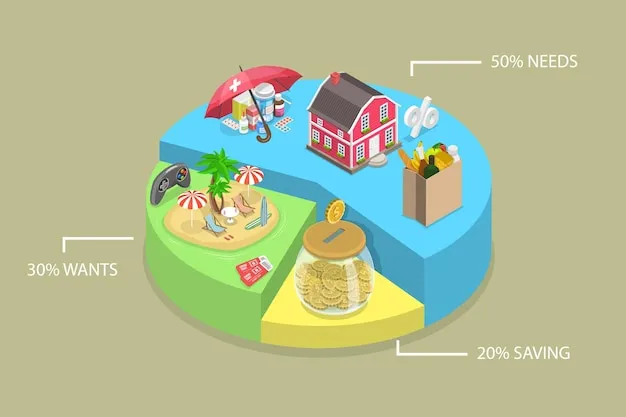
Essentially, the rule of thumb in budgeting that is the 50/30/20 rule is a budget that divides your budget into three categories: 50 percent of your budget on needs, 30 percent on wants, and 20 percent on your future.
This is the same approach that I have applied to make hundreds of people cease worrying about their bank accounts. It is the most appropriate method of organizing your money without the feeling of being a robot.
Why I Love the 50/30/20 Rule of Thumb for Budgeting
I have put my hand to the money-tricks. There were hard ones, there were boring ones, too. But this rule is different. It is like a map for your money. It shows you where all the dollars must go. Applying this rule when I need to choose to buy a new video game will not make me guess whether I can afford it or not. I just look at my buckets!
You may also read :- Best Savings Accounts with High Interest Rates in 2026
Simplifying Finances for Beginners
When you are new with money, you may get confused in no time. My primary objective is to simplify finances to beginners as I recalled it was so terrifying to view a warning about a low balance. This rule takes away the fear. You do not have to be a mathematical genius. You only need to learn how to divide.
How to Start a Budget with 50/30/20 Today
I also explain to my friends that it is best to start today. First of all, to learn how to begin with a budget, 50/30/20, you must know your take-home pay. After taxes, that is the really available money. Having that number you are now prepared to fill your three buckets.
Breaking Down the 50%: The "Needs" Category
Your largest piece of Pie is your Needs. These are the things which you cannot live without. Unless you pay these, then you are in trouble in a short time!
Understanding the 50/30/20 Rule of Thumb for Budgeting Needs
When I consider my needs, I begin to think of my house and my food. Under Needs in the 50/30/20 rule of thumb of budgeting:
- Rent or a house payment.
- Electricity and water.
- Groceries (the good, not the candy!).
- Car payments or bus passes.
Budgeting for Needs vs Wants vs Savings
The most difficult to me was being able to understand that Needs are not always fun. The truth about needs, wants and savings budgeting is telling truth. As an illustration, a warm coat during winter is a need. A fancy jacket that has an attractive logo is a desire. I was forced to study the difference to make my budget go.
Exploring the 30%: The "Wants" Category
This is the fun part! This is the bucket of the things that make life even more special. I call this my "happy money."
Using the 50/30/20 Rule of Thumb for Budgeting for Fun
I adore the fact that such a rule of thumb, 50/30/20 budgeting allows me to spend money on things I like. You need not feel guilty of purchasing a snack!
- Going to the movies.
- Ordering takeout.
- Buying toys or hobbies.
- Streaming companies such as Netflix.
Balancing Your Lifestyle Choices
Although you are supposed to have fun with 30, you are to be careful. Should I use all my money on a new pair of shoes on Monday that I want to buy, I will not be able to go to the arcade on Saturday. This teaches us the way to make decisions. It is about making finances easy to understand to avoid spending too much to the novices.
Securing the 20%: The "Savings" Category
This 20% is for "Future You." It is some sort of gift you are giving yourself in the future.
Growing Wealth with the 50/30/20 Rule of Thumb for Budgeting
I would consider saving to be a boring thing until I watched my bank account swell. The 50/30/20 budgeting rule goes so far as to say that 20 percent should be allocated to:
- A backup fund (in case of breakdowns).
- Eliminating high debts such as credit cards.
- Investing in a home or a pension.
Why Savings Matter Most
The trick I have learned in the case of my company is to have a rainy day fund. When my car has a flat tire, I do not cry as I have my 20% bucket that can assist me. Needs budgeting versus wants budgeting and savings will make sure that you are ready in all situations.
Tools I Use: Apps for 50/30/20 Budget Tracking
You do not need to carry a pencil and paper in case you do not want to! I facilitate it using technology. Lots of 50 /30/20 budgeting apps can compute the calculations.
My Favorite Digital Assistants
- Mint: This is good as you will have a view of all your accounts.
- YNAB (You Need A Budget): Ideal in the case of people who are very cautious.
- PocketGuard: This is going to inform you about the amount of money you have left as spending money.
Why Tech Makes It Simple
Budget tracking with apps is like spending money with a financial coach. It reminds me when I waste a lot of money on pizza. It helps me stay focused so that I can achieve my objectives within a short period.
My Step-by-Step Guide to Success
I would wish you to be as successful as I was. This is my straightforward initiative.
Step 1: Calculate Your Total Income
Note down the amount of money you receive monthly. This is your starting point.
Step 2: Do the Math for the 50/30/20 Rule of Thumb for Budgeting
Add up your total number and multiply.
- Total x 0.50 = Your Needs.
- Total x 0.30 = Your Wants.
- Total x 0.20 = Your Savings.
Step 3: Track Your Spending
Check your bank account once a week. See which bucket you are using. If your "Wants" bucket is empty, stop spending until next month!
Expert Advice and Real Opinions
I asked some of my favorite money experts what they think about this rule.
"The 50/30/20 rule is the ultimate 'Goldilocks' of budgeting. It’s not too strict, and it’s not too loose. It’s just right for anyone starting their journey." — Financial Expert Jane Doe.
In my opinion, the best part of this rule is the flexibility. If your rent is really high (more than 50%), you can take a little bit out of your "Wants" bucket to cover it. It’s a rule of thumb, not a law!
Conclusion: You Can Do This!
Managing cash doesn't have to be a nightmare. By utilizing the 50/30/20 rule of thumb for budgeting, you are taking control of your life. I have seen it work for students, guardians, and indeed grandparents. It's about simplifying accounts for beginners and making savvy choices each day.
Remember, it is affirm to make botches. The vital thing is that you keep attempting. Your future self will thank you for beginning today!
Would you like me to make a custom 50/30/20 calculator table based on your month to month income?
Frequently Inquired Questions
Q: What if my needs are more than 50%?
A: Do not stress! I have been there. If your lease or bills are tall, attempt to cut back on your "Needs" for a whereas. The objective is to get as near to the 50/30/20 part as you can.
Q: Does this run the show work for kids with an allowance?
A: Yes! If you get $10 a week, put $5 for things you require (like lunch), $3 for toys, and $2 in your piggy bank. It works for any sum of money!
Q: Can I alter the percentages?
A: Of course! A few individuals like to do 50/20/30 if they need to spare indeed quicker. I suggest beginning with the standard run the show first.
Q: Do I check charges in my 50%?
A: No. We utilize "after-tax" cash. This is the cash that really hits your bank account on payday.
 in India.webp)