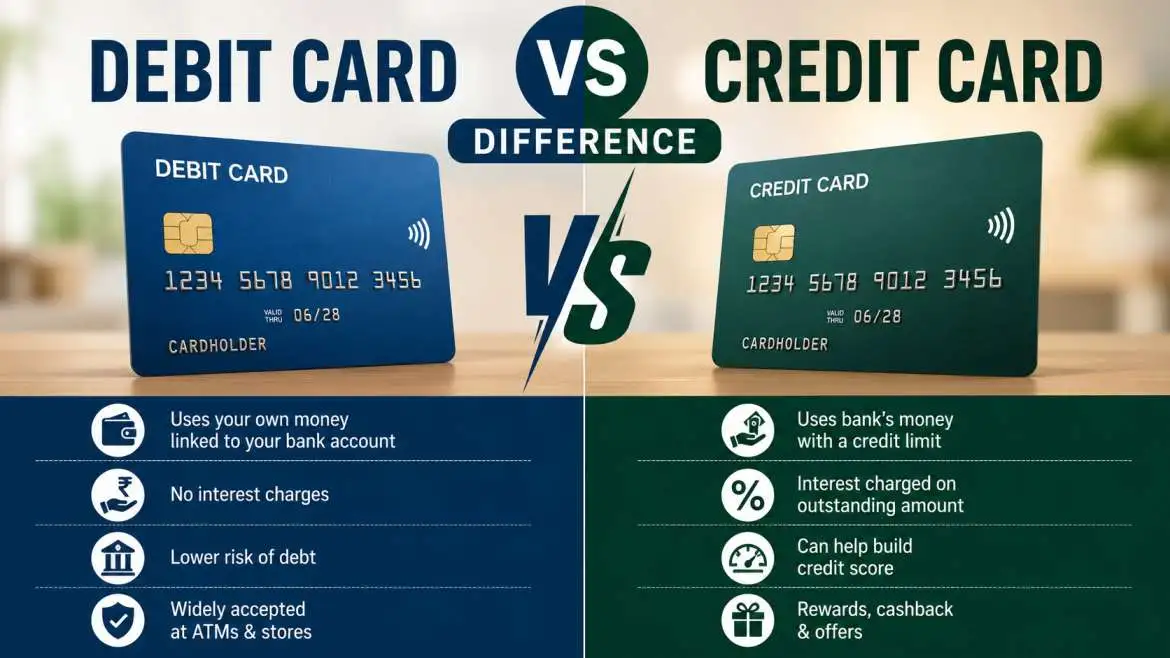
Suppose that you have two boxes of money. One is one you require at present such as a snack or a movie ticket. The other box is money you are saving to use in the future e.g. a new bike or a video game. And in a manner that is how bank accounts do work, too!
Checking and savings account are the two most prevalent ones. They are both helpful, and they are made to do various jobs. Learning how to Difference Between Checking and Savings Account is one of the most intelligent initial steps you could make in regards to your money. Let us simplify it in a simple, friendly manner.
The Main Goal: What Is Checking and Savings Account For?
The largest Difference Between Checking and Savings Account is the purpose. Consider them as instruments of doing things.
A Checking Account is Your Everyday Money Hub
This is the account that is used to spend. It’s built for action. Money comes in and out very much. You use it for your daily life.
- Automatic or online payment of bills.
- Purchasing something at the shop or a restaurant with debit card.
- Checks on writing (however, less so now!).
- Withdrawing cash from an ATM.
- You can have the direct deposit set up so that your paycheck deposits directly.
It is created to provide you with an easy and frequent access to your money. It is about convenient and transactions.
You may also read :- How to Invest Money in SIP for Beginners: Your Path
A Savings Account is Your Money-Growing Corner
This is your "saving" account. It’s built for patience. It is primarily tasked with assisting your money in growing in a slow and safe manner.
- Setting up an emergency fund to use in case of unexpected expenses, such as car repair.
- Saving towards something nice, such as a holiday, a car down payment or a gift.
- Keep money you are not currently in need of at a distance.
- Interest earned, a kind of a token gift the bank is giving you that your money is in the bank.
- It is all about amassing and getting a decent rate of profit. It’s not for daily spending.
Key Feature Comparison: A Side-by-Side Look
We should make a direct comparison of the key features of checking and savings accounts.
Access and Transactions: How Do You Get Your Money?
This is one of the large areas of divergence. Accessibility of funds is very different with each account.
- Checking Accounts: Provide numerous options of accessing money. You normally get a debit card, have access to ATM, write checks and online transfers any time you wish. The number of times to withdraw or deposit money is also normally unrestricted.
- Savings Accounts: Are there regulations to promote saving. The Federal Rule D (which is now suspended, but is still in effect in many banks) restricted some forms of withdrawals or transfers to six a month. Although money can be transferred easily at times via an app, a debit card is not often directly associated with it and can be used in stores. The point is that you should think twice before withdrawing money.
Interest Earnings: Which Account Helps Your Money Grow?
It is in this area that savings account work wonders. One of the central advantages is the opportunity to generate interest.
- Checking Accounts: Most of the traditional checking accounts would pay little or no interest. There are also some so-called high-yield checking accounts, but they are usually highly contingent (such as a large number of debit cards uses).
- Savings Accounts: Are meant to get the interest as time passes. As the interest rates fluctuate, you will always have your money in a savings account working to increase itself even in an incremental manner. That is the strength of the compound interest, you get interest on your initial amount of cash and the interest earned on the interest!
Fees and Requirements: What Do You Need to Watch For?
Banks also maintain rules of maintaining accounts. Understanding the fees that are common in banks will make you avoid them.
- Checking Accounts: Could include a monthly service fee when you do not satisfy some requirements, such as maintaining a minimum balance or make a direct deposit. Their overdraft fees may also be charged in case you spend more than you have.
- Savings Accounts: This may also require minimum balance to open the account or escape a monthly fee. Never forget to check the terms and conditions of the account.
The Debit Card Difference
This is a mere, practical dissimilarity.
- Checking Accounts: Checking accounts always include a debit card to use in shopping and using the ATM.
- Savings Accounts: Includes no debit card to use in the store. You could have an ATM card so that you could withdraw cash in a machine, but not swipe in a checkout. This keeps your savings saved with the aid of this physical barrier.
Pros and Cons: The Quick Summary
Checking Account Pros:
- Final convenience in day to day spending.
- Numerous methods of obtaining cash (debit card, checks, ATMs).
- Ideal in taking care of bills and daily expenses.
Checking Account Cons:
- Normally charges minimal or no interest.
- May result in excess spending without control.
- May have monthly fees.
Savings Account Pros:
- Grow your money through interest income.
- Offers an alternative space that is not money spending.
- Promotes proper money management and ambition.
Savings Account Cons:
- Restrictions of some forms of drawbacks.
- It is not intended to be used in high frequency.
- Less interest than on other investments (such as stocks).
How to Use Them Together: A Winning Team?
You don’t have to choose one. As a matter of fact, it is more appropriate to employ both of them simultaneously! This has been termed as the one-two punch of personal finance.
- It gets into your checking account as your paycheck.
- You check to pay your monthly bills and daily expenses.
- When you receive pay up, you just in transit transfer an amount of money (even a small one) in the checking to the savings account. This is referred to as paying yourself first.
- Your emergency fund and the money towards your future goals are all contained in your savings account where they grow safely with interest.
- The rest is done in your checking account, comfortably and conveniently.
This system is healthy and accumulates wealth in the long run without making it difficult to live in your day to day life.
Which Account Is Right For You? Ask These Questions
Still unsure? Ask yourself:
- Do you have to pay bills and purchase things on a daily basis? → You require a checking account.
- Would I like to create a safety net or was I saving towards something? → You need a savings account.
- Would I like to have both? → You must have both sorts of bank accounts!
The majority begin by having a checking account and open a savings account shortly. They are the financial tools to supplement each other.
Final Thoughts: Start Simple, Grow Smart
One of the most important money skills is to be able to understand the main Difference Between Checking and Savings Account. It is not difficult, one is a spending and one is a saving bank. It is a simple system that gives you a great deal of control over you and your money by having a checking account that you use in your day to day activities and a savings account that you use to accomplish what you intend to in the future.
The best next step? In case you have a checking account only, you need to open a savings account today. With both of them, look up the rate of interest of your savings--you may get a savings account, which earns interest, online, which will enable your money to work a little harder. Start where you are, employ the right tool to do the job and see your financial confidence increase.
Frequently Asked Questions
Q: Will I make money loss in a savings or a checking account?
A: In America, your funds in both checking and savings deposit accounts are insured by FDIC insurance to the tune of up to 250000 dollars per depositor, per bank. This is in case the bank was not okay and you have no worries about your money. A bank crash will not take it away. Nevertheless, very low interest rates may cause a loss in the value of savings account over very long periods of time due to inflation.
Q: How many accounts of each of them should I have?
A: The vast majority prefer to have only one primary checking account so as to be not confused. You could also have several savings accounts with various objectives (e.g. one to save emergencies, one to go on a vacation, one to get a car). This is known as bucketing and it can be highly inspiring!
Q: Is it possible to open these accounts online?
A: Absolutely! The majority of banks and credit unions enable you to open a checking and savings account online in a few minutes. You will be required to have this information on hand, your Social Security Number and a driver’s license.
Q: What is the actual real-life implication of making the right account?
A: keeping your emergency fund in a savings account implies that the money is apart and accrues interest, and therefore it is not as appealing to reach out to your daily desires. The checking account is a sure way of making it easy to pay the bills and on time. By knowing how to use them, they will decrease the stress and give you confidence about your money.
Q: These accounts can be well found in credit unions?
A: Yes! The interest rates on savings accounts in credit unions are usually lower than those of some large banks and their fees are usually lower. They are an excellent alternative to both savings and checking products.
 in India.webp)