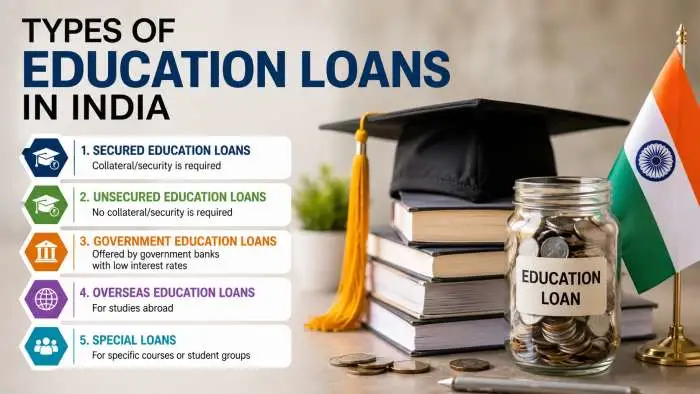
Planning for higher education is an exciting journey, but figuring out how to pay for it can feel overwhelming. The types of education loans in India are designed to help students just like you achieve their dreams without putting a huge financial burden on their families right away . This guide will walk you through every option, explaining the different types of education loans in India in simple words so you can make the best choice for your future.
Whether you want to study in a local college or a top university abroad, there is a loan for you. Banks and financial institutions offer many plans to cover your tuition, books, and even living expenses . Let's explore the main types of education loans in India together and find the perfect fit for your needs.
Types of Education Loans in India: By Study Location

One of the most basic ways to understand the types of education loans in India is by looking at where you want to study. Your choice of location will greatly affect the loan amount, interest rate, and rules for repayment.
Types of Education Loans in India for Domestic Studies
If you are planning to study in India, you can look for a domestic education loan. These loans are for students who get admission into recognized colleges and universities within the country .
- What they cover: These loans usually pay for your tuition fees, hostel or rent, cost of books, and other small expenses like lab fees or library deposits .
- Loan amount: The amount you can borrow for studies in India is generally lower than for abroad studies. You might get up to ₹50 lakh or even more depending on the bank and the course .
- Features: Domestic loans often have lower interest rates and simpler paperwork. It is easier for banks to check the reputation of Indian colleges, so they feel safer giving you the money .
You may also read :- Education Loan for Study Abroad: Best Interest Rates and Eligibility Guide
Types of Education Loans in India for Abroad Studies
For students with big dreams of studying in countries like the USA, UK, Canada, or Australia, there are special types of education loan for abroad studies . These loans are designed to handle the higher costs of international education.
- What they cover: Besides tuition, these loans cover your airfare, visa fees, health insurance, and living expenses abroad. They make sure you can focus on your studies without worrying about money .
- Loan amount: Banks offer much higher amounts for abroad studies. Loans can go up to ₹1.5 crore or even ₹3 crore in some cases . This is because studying in foreign countries is usually more expensive.
- Security: Because the loan amount is so high, banks often ask for strong security or collateral. This might mean pledging your house, land, or fixed deposits to get the loan approved .
Types of Education Loans in India: Secured vs. Unsecured
Another important way to sort the types of education loans in India is by whether they need collateral or not. This is a very practical point that affects your interest rate and how easy it is to get the loan.
Secured Education Loans (With Collateral)
A secured loan means you have to give the bank something valuable as a promise to pay back the money. This "something" is called collateral .
- What can be collateral? It can be your house, land, a fixed deposit, or even gold. Some banks also accept LIC policies or government bonds as security .
- Why choose this? If you have collateral, the bank's risk is lower. They know they can sell that asset to get their money back if you cannot pay. Because of this, secured loans usually have lower interest rates .
- Loan amounts: These loans are ideal for large amounts, especially for studying abroad where costs are high .
Unsecured Education Loans (Without Collateral)
An unsecured loan does not require any physical asset as security. The bank gives you the loan based on the promise of your future earnings and the financial strength of your co-applicant .
- Who can get it? These loans are often for smaller amounts, usually up to ₹7.5 lakh or ₹10 lakh. They are also given for courses at top institutions where the student has a very good academic record .
- Why choose this? The biggest advantage is that you don't have to pledge your family's property. This makes it a great option for families who do not have assets to offer .
- Higher rates: Since there is no security, the bank takes on more risk. To cover this, the interest rates on unsecured loans are usually higher than on secured loans .
Which Education Loan is Best in India? Choosing the Right One
With so many choices, you might be asking, "Which education loan is best in India?" The honest answer is: the best loan is the one that fits your personal situation. What works for your friend might not be the best for you. Here is how you can figure it out.
How to Select the Best Type of Student Loan for Your Needs
When you are trying to select the best type of student loan, you need to look beyond just the interest rate. It's about the full picture .
- First, check your eligibility: Before you apply, check if you meet the bank's rules. They look at your age, your academic scores, the college you got into, and your family's income .
- Compare the total cost: Don't just look at the interest rate. Check for processing fees, which can be a percentage of the loan. Also, see if there is a margin money requirement, which is the percentage of the cost you have to pay from your pocket .
- Think about the future: Consider the repayment tenure, which is the time you get to pay back the loan. A longer tenure means lower monthly EMIs, but you will end up paying more interest overall . A shorter tenure means higher EMIs but less total interest.
Importance of Interest Rates in Student Loans
The interest rate is one of the most important parts of any loan. It decides how much extra money you will pay back on top of what you borrowed. The types of education loans in India have different rates based on the lender and the type of loan .
- Fixed vs. Floating Rates: Some banks offer a fixed interest rate, which stays the same for the whole loan period. This makes it easy to plan your budget. Others offer a floating interest rate, which can change with market conditions. Floating rates can go up or down, making them a bit uncertain but often lower at the start .
- Public vs. Private Banks: Public banks like SBI and Bank of Baroda usually offer lower interest rates compared to private banks. They are a popular choice for students looking for affordable options .
- Concessions: Many banks offer a small concession of 0.50% on the interest rate for girl students. So, always ask about special benefits when you apply .
Types of Education Loans Based on Courses

Banks also offer specialized loan schemes based on the type of course you are pursuing. This is another way the types of education loans in India are divided .
Loans for Professional and Graduate Studies
These are the most common education loans. They are for students who want to pursue full-time undergraduate or postgraduate degree courses.
- Popular schemes: Most public and private banks offer a general student loan scheme. For example, SBI's Student Loan Scheme covers a wide range of UG/PG degrees, diplomas, and professional courses in India and abroad .
- Special rates: Some banks have special schemes for students who get into premier institutions like IIMs, IITs, or ISB. They offer these students lower interest rates because these courses have a very high chance of leading to great jobs .
Career Education and Skill Development Loans
There are also loan schemes for students who want to learn a new skill or take short-term career courses. These are important types of education loans in India for vocational training .
- Skill Loan Scheme: The government and banks have a special Skill Loan Scheme for students who want to do courses offered by ITIs, Polytechnics, or other recognized skill development centers .
- Small loan amounts: These loans are for smaller amounts, usually between ₹5,000 and ₹1.5 lakh. They are designed to help students become job-ready without taking on a huge financial burden .
Shaurya Education Loan and Other Special Schemes
Some banks offer special loan schemes for specific groups of people. For example, SBI's Shaurya Education Loan is for the children or spouses of defense personnel, coast guard, and central armed police forces .
- Benefits: These special loans often have lower interest rates and easier terms. They are a way for banks to support the families of people who serve the country .
- Tax Benefits: It's also important to know that the interest you pay on any education loan is tax-deductible in India. Under Section 80E of the Income Tax Act, you can claim a deduction on the interest paid for up to 8 years .
Expert Quote: "Choosing the right education loan is not just about getting money for your fees; it is about investing in your future without creating unnecessary financial stress. Always read the fine print and consider the long-term cost of your loan," says Manisha Lal Khandpur, a personal finance expert .
Conclusion
Navigating the world of student financing might seem complex, but it becomes much easier when you break it down. Understanding the different types of education loans in India is the first step to making a smart decision for your academic career. Whether you choose a secured loan for its lower interest rates or an unsecured option for its convenience, remember to compare offers from various banks and NBFCs .
Take the time to calculate your total expenses, check your eligibility, and choose a repayment plan that gives you peace of mind. With the right loan and a clear plan, you can focus on what matters most: studying hard and building the bright future you deserve. Start your journey today by exploring the options and choosing the loan that fits you best.
FAQs About Types of Education Loans in India
1. What are the four main types of loans in the education sector?
The four main ways to categorize education loans are: by location (Domestic vs. Abroad), by security (Secured vs. Unsecured), by the course (Graduate, Professional, or Skill-based), and by lender (Public banks, Private banks, or NBFCs) .
2. Can I get an education loan without collateral for studying abroad?
Yes, some banks and NBFCs offer unsecured loans for abroad studies . However, the loan amount is usually lower, and interest rates are higher. Approval depends on your academic profile, the university's ranking, and your co-applicant's financial strength .
3. How do I know which types of education loans in India are best for me?
The best loan depends on your needs. Start by estimating your total costs . Then, compare offers from different banks. Look at the interest rate, processing fees, margin money, and repayment tenure. Choose the option that gives you the best terms and fits your financial situation .
4. What is the interest rate for SBI education loans?
SBI offers competitive rates. Their Student Loan Scheme starts at around 9.90% p.a., while the Scholar Loan Scheme for premier institutes can start as low as 6.90% p.a. The exact rate depends on the loan amount and whether you provide collateral .
5. What is a moratorium period in an education loan?
The moratorium period, also known as the repayment holiday, is the time after your course ends during which you don't have to start paying back the loan . Most banks give a period of 6 months to 1 year after course completion to find a job and start earning
 in India.webp)