in India.webp)
The Margin Trading Facility (MTF) in India lets you buy more shares than your available cash allows by borrowing from your broker. You pay a margin (part of the total value), and the broker funds the rest, charging interest on the borrowed amount. While MTF can boost your profits when stocks rise, it can also magnify losses if prices drop.
This guide explains the MTF meaning, how it works, the benefits, risks, charges, and who should use it. With the MTF book crossing ₹96,000 crore in August 2025, understanding this facility is more important than ever .
What is Margin Trading Facility (MTF)?
The Margin Trading Facility, or MTF, is a service stock brokers provide. It lets you buy shares by paying only a part of the total amount upfront. The broker pays the rest for you. Think of it like a short-term loan for buying stocks.
You need to open a Demat and trading account with a broker who offers MTF. The amount you pay is called the margin money. The money the broker gives you is called the funded amount. The shares you buy stay in your Demat account but are pledged as collateral to the broker. This means the broker holds them as security for the loan.
You may also read :- Best ETFs to Invest in India (2026): Top Nifty and Sectoral Funds
Why is Margin Trading Facility India Becoming So Popular?
Margin Trading Facility India has seen a huge surge recently. The total MTF exposure across NSE and BSE grew 19% year-on-year to ₹1.02 lakh crore in September 2025 . Several factors are driving this growth.
First, retail participation has increased massively. More people are entering the stock market and want to take larger positions. Second, brokers are offering attractive MTF schemes with competitive interest rates.
Third, SEBI has been tightening rules for equity derivatives. This has pushed some traders, especially younger ones, towards margin trading as an alternative to costlier options .
"The MTF segment typically attracts aggressive retail traders," says Devarsh Vakil, head of prime research at HDFC Securities . The shift from single-stock futures to MTF has been notable after tighter derivatives rules.
How MTF Works: A Simple Example?
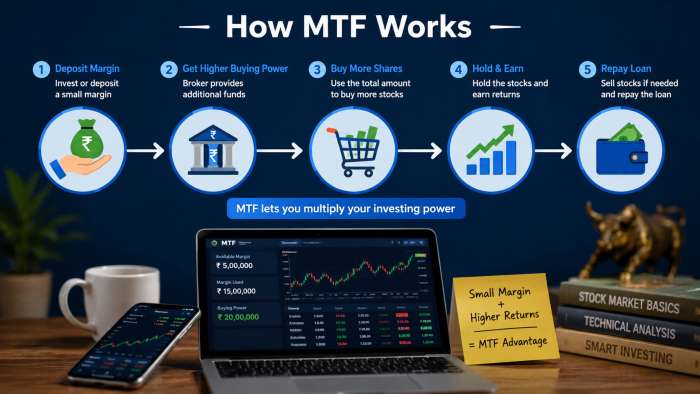
Understanding how MTF works is easy with an example. Let’s say you want to buy shares worth ₹1,00,000. Your broker offers 4x leverage.
Your margin (your money): ₹25,000 (25% of the value)
Broker’s funding: ₹75,000 (75% of the value)
Total buying power: ₹1,00,000
You pay just ₹25,000 to control shares worth ₹1,00,000. The shares are purchased and pledged to the broker. Now, if the stock price goes up by 10%, your shares are worth ₹1,10,000. You sell and repay the broker ₹75,000 plus interest. Your profit is on the entire ₹1,00,000 position, not just your ₹25,000.
However, if the stock falls by 10%, your shares drop to ₹90,000. The broker still needs his ₹75,000 back. The loss is on the full position, making it much larger than if you had only invested your own money. This example highlights why using MTF requires caution.
"The risks are obvious - while margin trading enhances profits, it inflates losses as well. Particularly during times of enhanced volatility in the market, margin trading raise the market's volatility further." - Manishi Raychaudhuri, Founder and CEO of Emmer Capital Partners .
NSE Margin Trading Facility: Eligibility and Rules
The NSE margin trading facility is governed by strict SEBI rules. Not all stocks are eligible for MTF. You can only buy shares classified as 'Group I securities'. These are highly liquid stocks.
As per SEBI rules, Group I includes equity shares and units of Equity ETFs . Stocks available for trading in the F&O Segment are also eligible for MTF.
Key Rules for MTF:
- Eligible Brokers: Only corporate members with a net worth of ₹3 crores and above can offer MTF .
- Client Consent: You must give written consent to your broker for availing MTF .
- Unique Client Code: All clients must have a single unique client code per member. MTF and Non-MTF accounts are segregated .
- Maximum Exposure: A member cannot exceed the total borrowed funds plus 50% of his net worth .
- Total Indebtedness: This cannot exceed 5 times the member's net worth .
Margin Requirements:
The initial margin depends on the stock category :
- For F&O stocks: VaR + 3 times Extreme Loss Margin (ELM).
- For non-F&O stocks: VaR + 5 times ELM.
Benefits of MTF
Using MTF has several benefits that make it an attractive tool for traders.
Increase Your Buying Power
The most significant advantage is enhanced buying power. You can buy more shares than your capital allows . With MTF, you can take larger positions and participate in opportunities that would otherwise be out of reach.
Potential for Higher Returns
Leverage is a double-edged sword, but on the upside, it can amplify your profits . A small move in a stock price can generate significant returns on your invested capital. This is ideal for short-term trades where you spot a clear opportunity.
Act on Time-Sensitive Opportunities
Markets move fast. When a good opportunity appears, you may not have all the funds ready. MTF allows you to act immediately . You can take a position worth ₹80,000 with just ₹20,000 using 4x leverage. This speed can be crucial in volatile markets.
Hold Positions for Longer
Unlike intraday trading, MTF lets you hold shares beyond a single day . You can carry forward your positions for days, weeks, or even up to a year, depending on your broker's policy . This is useful for swing traders and investors with a short-to-medium term view.
Risks of MTF
While MTF can boost returns, the risks are equally significant. Understanding the benefits and risks MTF carries is essential before you start.
Losses Can Exceed Your Capital
When you buy on margin, your losses can be greater than your initial investment . If the stock price falls sharply, the broker will still want their money back. Your entire capital can be wiped out, and you may even end up owing money.
Margin Calls and Forced Liquidation
A margin call is a demand from your broker to add more funds to your account . This happens when the value of your holdings drops, and the margin falls below the required level.
If you fail to meet the margin call, the broker has the right to sell your shares to recover the loan. This is called forced liquidation . They can do this without your prior consent. You may be forced to sell at a low price, locking in a substantial loss.
Accumulating Interest Costs
You pay interest on the money borrowed from the broker. This interest is charged daily . If you hold a position for a long time, the interest can eat into your profits . In some cases, it can even turn a winning trade into a losing one.
Volatility and Gap Risk
Stock markets can be volatile. Prices can gap down sharply due to bad news or unexpected events. This can trigger an immediate margin call. If the gap is huge, the broker might liquidate your position at a price much lower than you anticipated . This risk is even higher when using high leverage.
"Initial margins collected by brokers from clients prevent excessive leverage and avoid systemic risk build up." - SEBI .
Margin Trading Facility Interest Rate

The Margin Trading Facility interest rate is a crucial factor affecting your profitability. Brokers charge interest on the funded amount. The rate varies between brokers.
- Interest rates typically range from 9% to 18% per annum .
- Some brokers, like Navia Markets, offer rates starting at 14.99% per annum for higher funding amounts .
- Dhan charges interest from 0.0342% to 0.0425% per day, which works out to 12.49% to 15.49% per annum .
- Zerodha charges a flat 0.04% per day (about 14.6% per annum) .
How is interest calculated?
Interest is charged on the outstanding debit balance at the end of each day. For example, if you borrow ₹80,000 and the interest rate is 14.99% per annum, the daily interest is roughly ₹32.85 . The interest is calculated from T+1 day (the settlement day) until the day you clear the position .
| Funded Amount | Annual Interest | Cost Per Day |
|---|---|---|
| ₹80,000 | 14.99% | ₹32.85 |
| ₹1,00,000 | 14.99% | ₹41.06 |
| ₹2,00,000 | 12.49% | ₹68.44 |
Margin Trading Facility Charges
Besides interest, several other Margin Trading Facility charges can affect your total cost. These differ between brokers and can significantly impact your net profit.
Brokerage
Brokerage is the fee the broker charges for executing your trade . For MTF orders:
- Zerodha charges ₹20 or 0.3% per executed order, whichever is lower .
- Dhan charges a flat fee structure.
- Brokers with uncapped percentage-based brokerage can become expensive for large orders .
Pledge and Unpledge Charges
When you buy shares via MTF, they are pledged to the broker. Similarly, when you sell, they are unpledged. The broker charges a fee for this .
- Zerodha charges ₹15 + GST per ISIN per pledge and unpledge request .
- This fee is charged once per day per stock.
Square-off Charges
If your position is squared off by the broker due to a margin shortfall, they may levy a square-off charge. For instance, Zerodha charges ₹50 + GST per order squared off .
Comparison of Charges
| Broker | Interest Rate (p.a.) | Brokerage | Pledge/Unpledge Charges |
|---|---|---|---|
| Zerodha | ~14.6% | ₹20/0.3% (lower) | ₹15 + GST each |
| Dhan | 12.49%-15.49% | Flat | Varies |
| Navia | 14.99%-21.99% | Varies | Varies |
Who Should Use MTF?
MTF is not for everyone. It's a tool best suited for specific types of investors and traders.
Experienced Traders and Investors
MTF is ideal for experienced investors who understand market patterns and technical analysis . They have the knowledge to make informed decisions and manage risks effectively.
Short-Term and Intraday Traders
Short-term traders can use leverage to profit from market volatility. They employ MTF to execute rapid transactions and maximize earnings without requiring large upfront funds .
Investors with a High Risk Appetite
MTF involves borrowing and leverage. It suits investors who can handle high risk . Such investors have the financial capacity to absorb losses and meet margin calls.
Disciplined Traders with Strong Research
MTF works best for disciplined traders who follow strict risk management rules. They avoid overleveraging and emotional decision-making . They use strong research to pick their stocks.
"MTF is an investment tool option that allows investors to increase their purchasing power by borrowing funds from a broker." - Rupeezy .
How to Use MTF Responsibly?
Using MTF wisely is key to success. Here are some practical tips:
- Choose the Right Stocks: Invest in fundamentally strong, liquid stocks. Avoid highly volatile penny stocks.
- Set Stop-Loss Orders: Stop-loss orders limit your losses. If the stock price falls to a certain level, the stop-loss triggers a sale.
- Monitor Regularly: Keep an eye on your positions and the market. Be aware of margin requirements.
- Do Not Overleverage: Just because you have 4x leverage doesn't mean you should use it all. Borrow only what you need.
- Understand the Costs: Know the interest rate, brokerage, and other charges before you start.
- Have a Clear Exit Plan: Know when to take profits or cut losses. Do not hold a losing position hoping it will recover.
Final Opinion: Is Margin Trading Facility India a Good Option?
The Margin Trading Facility India offers a way for traders to amplify returns by leveraging their capital. It's a powerful tool. However, it comes with substantial risks that can lead to losses exceeding your investment.
My professional view is this: MTF is a good option for experienced traders with a high-risk tolerance. It is not suitable for beginners. If you understand the markets, have a disciplined approach to risk, and use leverage cautiously, MTF can be a useful addition to your trading toolkit.
However, if you are new to the stock market, start with your own funds. Learn the basics of investing and risk management. Once you have sufficient experience, you can consider using MTF.
The recent data shows the MTF book has grown to over ₹96,000 crore . This indicates a maturing market where more investors are using leverage. Yet, the same data reminds us of the need for caution. Always remember the golden rule: use leverage wisely, and never invest more than you can afford to lose.
FAQs on Margin Trading Facility
1. What is the meaning of Margin Trading Facility?
The Margin Trading Facility (MTF) is a broker service that lets you buy shares by paying only a part of the total value upfront. The broker provides the remaining funds as a loan, and you pay interest on the borrowed amount. The purchased shares are kept as collateral .
2. What is the difference between MTF and Intraday Trading?
MTF allows you to hold shares for multiple days, weeks, or months. Intraday trading, on the other hand, requires you to square off (buy and sell) all positions on the same day . MTF is more flexible but carries higher interest costs compared to intraday margin products.
3. How does SEBI regulate Margin Trading Facility?
SEBI regulates MTF through strict rules. Only certain stocks (Group I securities) are eligible. Brokers must be corporate members with a net worth of ₹3 crores or more . They must collect a minimum margin (VaR + ELM) and ensure clients provide consent. The maximum exposure for a broker is limited by his net worth and borrowed funds.
4. What happens if I cannot meet a margin call?
If you fail to meet a margin call, your broker can liquidate your holdings to recover the loan . This is called forced liquidation or square-off. The broker can sell your shares at the prevailing market price, often without your prior consent.
5. Can I pledge my existing shares to get MTF?
Yes, you can pledge existing shares or mutual funds to your broker as additional collateral . This can increase your margin limit and allow you to borrow more funds for trading under MTF.