
Are you trying to decide between keeping your money in a bank or putting it into the stock market? This is a common question for many people in India today. In the past, most families only used savings accounts or fixed deposits. Today, things are changing. New mobile apps allow you to start with very small amounts of money. This is called micro-investing. You can now start with as little as ₹10, ₹100, or just the "spare change" from your daily spending.
In this guide, we will look at micro-investing vs. savings in India to help you choose the right path for your financial future in 2026.
What is a Savings Account?
A savings account is a safe place to keep your money in a bank. In India, most banks give you a small amount of interest for keeping your money with them. It is very easy to use. You can take your money out whenever you need it at an ATM or through an app.
The Benefits of Savings
- High Safety: Your money is very safe in a bank. Even if the bank has trouble, the government protects up to ₹5 lakhs of your money through the DICGC.
- Easy Access: You can spend your money instantly using UPI or a debit card.
- No Risk of Loss: The balance in your account will not go down because of the stock market.
The Downside of Savings
The main problem is that the interest rate is often low. In 2026, many big banks offer around 3% to 4% interest per year. This might not be enough to beat inflation. Inflation is when the price of things like food and fuel goes up. If your money grows slower than prices, you are technically losing buying power.
You may also read :- How to Choose the Right Budgeting Method
What is Micro-Investing?
Micro-investing is a way to buy stocks, mutual funds, or digital gold with very tiny amounts of money. Instead of waiting until you have ₹10,000, you start with what you have in your pocket.
How it Works
Many people use spare change apps in India. For example, if you buy a coffee for ₹188, the app rounds it up to ₹200. It then takes that extra ₹12 and invests it for you. Over a month, these small bits of money add up to a significant amount.
Micro-Investing vs Savings in India: The Comparison

To help you decide, let's look at the main differences between these two choices.
| Feature | Savings Account | Micro-Investing |
| Minimum Amount | Usually ₹0 to ₹1,000 | Can be as low as ₹1 |
| Risk Level | Very Low | Moderate to High |
| Expected Returns | 3% - 7% (Fixed) | 10% - 15% (Estimated) |
| Access to Money | Instant | Takes 1 to 3 days |
| Best For | Emergency funds | Long-term growth |
Is Micro-Investing Worth It?
You might wonder if investing such small amounts really matters. The answer lies in compound interest on small investments in India.
When you invest, you earn a return. Then, you earn a return on that return. Over 10 or 20 years, even ₹500 a month can grow into a large sum.
Why it is Worth It:
- Builds a Habit: It teaches you to save and invest without feeling the pain of losing a lot of money at once.
- Beats Inflation: Usually, the stock market grows faster than bank interest over a long time.
- Low Barrier: You do not need to be a math expert or a rich person to start.
Best Micro-Investing Apps in India 2026
If you want to try this, there are many great apps available. Here are the top choices for this year:
1. Groww
Groww is one of the most popular apps. It is very simple to use. You can start a "Systematic Investment Plan" (SIP) with just ₹100. It is great for beginners who want to buy mutual funds.
2. Jar
Jar focuses on Digital Gold. It automatically rounds up your spending and buys 24K gold with the spare change. Since gold prices often go up over time, it is a steady way to grow your wealth.
3. INDmoney
This app is unique because it allows for fractional shares investing in India. This means you can buy a tiny piece of an expensive company like Google or Apple with just a few dollars. You don't need to buy a whole share.
4. Zerodha (Coin)
Zerodha is best for people who want more control. Their Coin app lets you buy direct mutual funds, which means you don't pay extra commissions.
High-Yield Savings vs Spare Change Apps in India
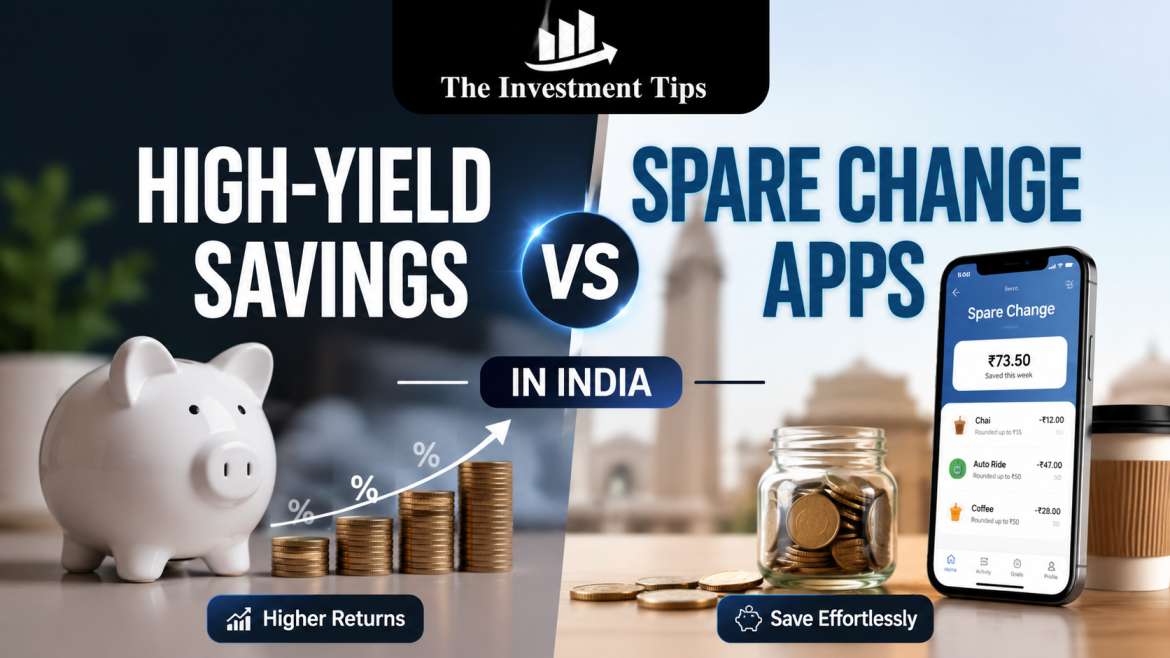
In 2026, some new digital banks are offering high-yield savings. These accounts might give you 6% or 7% interest, which is much better than old banks.
However, even high-yield savings are "fixed." They do not have the growth potential of the stock market. Spare change apps, on the other hand, are "market-linked." This means they can go up much higher, but they can also go down if the market performs poorly.
Automated Investment vs Manual Savings in India
One big secret to getting rich is automation.
- Manual Savings: You wait until the end of the month. If you have money left, you put it in a jar or a separate account. Most people spend the money before they can save it.
- Automated Investment: The app takes the money as soon as you get paid or every time you spend. You don't have to think about it.
Automated investing is usually much better because it removes the "human" mistake of forgetting to save.
Understanding Compound Interest
The real magic of micro-investing is how it grows over time. Let's look at an example.
Imagine you invest ₹500 every month in a mutual fund that gives a 12% return.
- After 5 years, you have about ₹41,000.
- After 10 years, you have about ₹1,15,000.
- After 20 years, you have about ₹5,00,000.
Even though you only put in small amounts, the "interest on interest" makes the total much larger. This is why starting early is more important than starting with a lot of money.
The Risks You Should Know
While micro-investing sounds great, it is not perfect. You must know these three things:
- Market Risk: Unlike a bank, your investment value can go down. If the stock market crashes, your ₹1,000 might become ₹800 for a while.
- App Fees: Some apps charge a small monthly fee. If you only invest ₹10 and the fee is ₹5, you are losing money. Always check the fees first.
- Not for Emergencies: It takes a few days to get your money back from an investment app. Always keep some cash in a regular savings account for emergencies.
The Mistakes to Avoid
Many people try micro-investing and then quit because they make these mistakes. Do not be one of them.
Checking your app every day. This will make you crazy. The market moves every day. Sometimes it is up, sometimes down. If you check daily, you will feel scared when it is down. You might sell at the wrong time. Check once a month at most.
Selling when the market drops. This is the biggest mistake. When the market drops, your investments are on sale. It is a good time to buy more, not sell. The only time you lose money is if you sell when the price is low. If you hold, the market will likely go back up. It always has in history.
Investing money you need next week. This is dangerous. What if the market drops and you need that money for rent? You will be forced to sell at a loss. Always keep your short-term money in a savings account. Only invest long-term money.
Trying to pick the next hot stock. Beginners should not buy single company stocks. That is like gambling. Buy a simple index fund that spreads your money across many companies. It is safer and easier.
How to Get Started (Step-by-Step)

If you are ready to move from just saving to micro-investing, follow these steps:
Step 1: Build a Small Safety Net
Before you invest in the market, keep at least one month of expenses in a regular bank account. This is your "emergency fund."
Step 2: Pick One App
Don't download five apps at once. Pick one that fits your goal. Use Jar for gold, Groww for mutual funds, or INDmoney for US stocks.
Step 3: Start Small
Set your daily or monthly limit to something you won't miss. Even ₹20 a day is a great start.
Step 4: Be Patient
Don't check the app every hour. Investing is like growing a tree. It takes years, not days.
Which One Should You Choose?
In the battle of micro-investing vs. savings in India, you don't actually have to pick just one. The smartest people do both.
Use a Savings Account for:
- Your monthly bill money.
- Your emergency fund.
- Money you need in less than a year.
Use Micro-Investing Apps for:
- Building long-term wealth.
- Learning how the stock market works.
- Saving for big future goals like a house or retirement.
By using both, you get the safety of a bank and the high growth of the market. Start today with whatever small amount you have. Your future self will thank you for it.
Summary of Key Points:
- Savings is for safety and quick use.
- Micro-investing uses the power of compounding to grow small amounts into large ones.
- Automation is the best way to ensure you actually save money every month.
- 2026 is the best time to start because Indian apps are now safer and easier to use than ever before.
The Future of Micro-Investing in India
India is changing fast. Ten years ago, only 5% of households invested in mutual funds. Today, it is over 10%. Experts think it could reach 20% in the next ten years. That means millions more Indians will start micro-investing.
The government and regulators are helping too. SEBI, the market regulator, has made rules that protect small investors. They have lowered fees and made things more clear. Apps have made investing as easy as ordering food.
In 2026, you have no excuse not to start. You do not need to be rich. You do not need to be smart about the stock market. You just need to start small, stay regular, and be patient.
Final Verdict: Which One Wins?
So, micro-investing vs savings. Which one wins? The answer is both. But for different jobs. Savings wins for safety and short-term needs. Keep your emergency fund here. Keep money for next year's goals here.
Micro-investing wins for building wealth over time. Put your long-term money here. Let it grow with the market. Let compound interest work its magic. If you only save, inflation will eat your money slowly. If you only invest, you might have to sell when the market is down if an emergency comes. You need both. But if you are young and you have a steady job, lean more toward investing. Your future self will thank you.
Start today with just ₹100 — because small investments made now can build big wealth later. Set up an automatic plan for next month. That small step is the difference between staying the same and changing your life. Your money can work for you. It just needs you to point it in the right direction. Now you know which way to go.
 in India.webp)