Taking a student loan is a big step, but repaying it doesn't have to be a lifelong burden. In India, you have several student loan repayment plans in India that offer flexibility, from a moratorium period to step-up EMIs. The key to stress-free repayment is to start planning early, pay at least the interest during your studies, and choose a tenure that fits your financial goals. By using government schemes like the interest subsidy and making small prepayments, you can reduce your total interest and close your loan faster than you think.
Understanding the Basics of Education Loan Repayment

The moratorium period is a crucial feature of student loan repayment plans in India. It is the "grace period" that starts from the day your loan is disbursed and lasts until you finish your course, plus an additional six months to one year . Most lenders, from public banks to NBFCs, offer this buffer to give you time to secure a job before your Equated Monthly Installments (EMIs) begin .
This period is often misunderstood as a "payment holiday." While you are not required to pay the principal, the interest on your loan continues to accumulate . Understanding this is the first step to managing your loan effectively.
How Interest Accrues During Your Studies
During the moratorium period, banks typically charge simple interest on the outstanding principal . This means you only pay interest on the original loan amount, not on the accumulated interest. However, if you choose not to pay this interest during your studies, it gets added to your principal amount (a process called capitalization). This increases the base on which future EMIs are calculated, significantly raising your total repayment amount.
For example, an expert at Axis Bank illustrated how paying interest during the moratorium can reduce the total interest outflow by over ₹1.2 lakh on a loan of just ₹8 lakh . So, your choices during this time have a huge impact on your education loan time period.
You may also read :- Education Loan Interest Rate 2026: SBI 8.15% Canara 9.40%
Types of Student Loan Repayment Plans in India
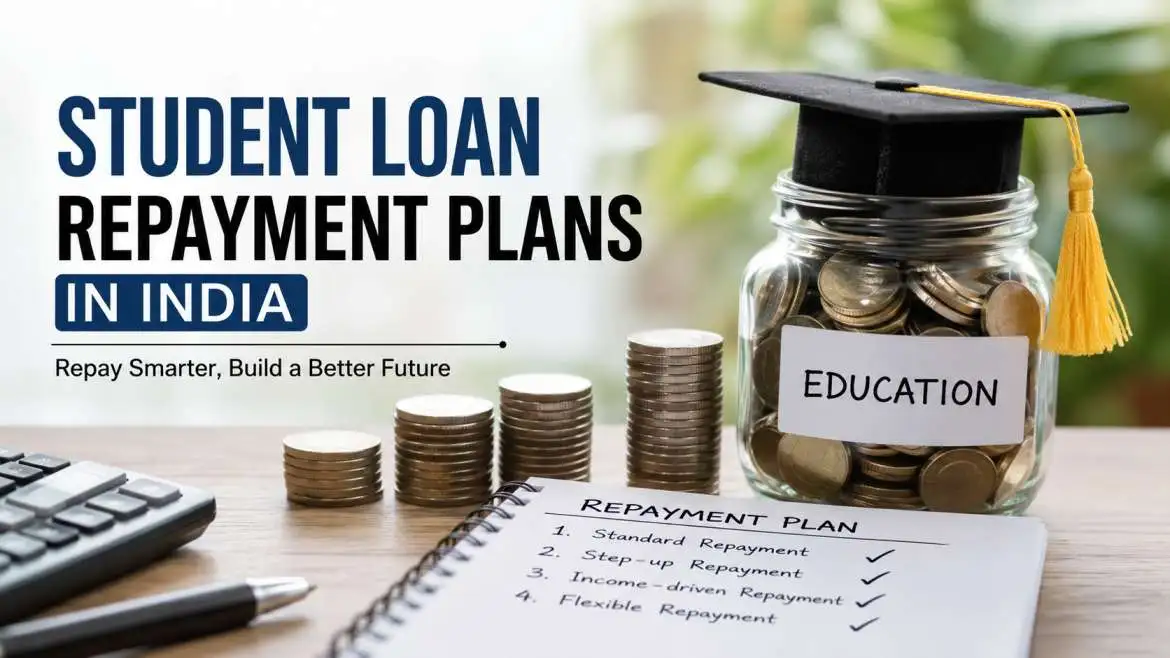
Standard Repayment Plan: The Fixed EMI Option
This is the most common repayment plan. After your moratorium period ends, you begin paying a fixed monthly EMI. This amount is calculated based on your principal amount, the interest rate, and the loan tenure. The tenure typically ranges from 5 to 15 years, with a maximum of 15 years as per RBI norms .
- Pros: Predictable monthly payments make it easy to budget.
- Cons: If you choose a longer tenure, you will pay significantly more interest over the life of the loan .
Step-Up Repayment Plan: Growing with Your Income
Also known as a progressive EMI plan, this option starts with lower EMIs that gradually increase over time. This is perfect for young professionals who expect their salary to grow steadily over the years .
- Ideal for: Students who are starting their careers and anticipate promotions and salary hikes.
- Benefit: It ensures your repayment burden remains manageable in the early years when your income is lower.
Income-Based Repayment: Flexible Payments for Unpredictable Incomes
Most big banks stick to their fixed rules. But some smaller finance companies and new-age digital lenders are more willing to bend. They understand that not everyone has a steady paycheck every month. If you are a freelancer or work for a startup, your income might go up and down. These lenders get that. They may offer you a plan where your monthly payment adjusts based on what you actually earn that month. It is not a standard option, but it is worth asking about if your income feels unpredictable.
This approach ensures that you don't default during months when your income dips, providing a safety net that many standard student loan repayment plans in India do not offer.
Proven Strategies to Reduce Your Education Loan Burden
Strategy 1: Pay the Interest During the Moratorium Period
This is the single most effective tip for reducing your loan burden. By paying the monthly simple interest while you are still studying, you prevent it from being added to the principal . This keeps your principal amount lower, reducing your future EMIs and the total interest payable. You can do this through internships, part-time jobs, or with the help of a co-borrower .
Strategy 2: Make Partial Prepayments with Bonuses and Windfalls
Whenever you receive a windfall—like a Diwali bonus, tax refund, or a cash gift—direct it towards your loan principal . According to RBI guidelines, most lenders do not charge a prepayment penalty on floating-rate loans . Even a single extra payment of one EMI per year can reduce your education loan tenure by several months.
Strategy 3: Leverage Government Subsidies and Tax Benefits
The Indian government offers a 3% interest subvention under the PM Vidyalaxmi scheme for students from families with an annual income of up to ₹8 lakhs . Additionally, the Central Sector Interest Subsidy (CSIS) provides a full interest subsidy during the moratorium for students from economically weaker sections (annual income below ₹4.5 lakh) studying technical or professional courses .
Don't forget to claim a deduction on the entire interest portion of your EMI under Section 80E of the Income Tax Act. There is no maximum limit on this deduction, and it is valid for up to 8 years .
Strategy 4: Choose a Shorter Tenure to Save on Interest
A 15-year tenure offers lower EMIs, but it is the most expensive way to borrow . If your starting salary allows, opt for the shortest possible tenure. A higher monthly commitment acts as forced savings, ensuring you don't pay interest on the same borrowed amount for over a decade.
Using Online EMI Calculators
For a simpler approach, use an online education loan EMI calculator . Websites like GyanDhan, Economic Times, and Bajaj Markets offer calculators that also account for your moratorium period and flexible disbursals . These tools provide an amortisation schedule showing the breakdown of principal and interest payments, helping you plan your finances better.
Government Support and Subsidies for Students
PM Vidyalaxmi Scheme: A New Hope for Students
Launched by the Union Cabinet in 2024, the PM Vidyalaxmi scheme provides collateral-free, guarantor-free loans to students who get admission to Quality Higher Education Institutions (QHEIs) . A key benefit is the 3% interest subvention support given every year to one lakh fresh students whose annual family income is up to ₹8 lakhs.
Credit Guarantee Fund Scheme for Education Loans (CGFSEL)
Under this scheme, banks provide loans of up to ₹7.5 lakh without collateral . This is a huge relief for students who lack assets to pledge as security, making higher education more accessible for the middle class.
How to Create a Monthly Budget for Loan Repayment?
Track Your Income and Expenses
Once your EMIs start, create a simple monthly budget. List down your fixed expenses, such as rent and groceries, and your discretionary spending, such as eating out and subscriptions. The money you save by cutting down on non-essentials can go directly towards your loan.
Set Up Auto-Debit or Standing Instructions
Set up an auto-debit on your bank account. This links your loan to your salary account. The bank will automatically take the EMI on the due date. You will never miss a payment by mistake. Missing payments hurts your CIBIL score badly. It also adds late fees to your loan. Some banks give you a small interest rate discount if you choose auto-debit. It is a small step that saves you from big headaches later. Just make sure you have enough balance in your account on that day.
Common Mistakes to Avoid During Loan Repayment
Ignoring the Interest During the Moratorium
Many students treat the moratorium as a complete holiday and ignore the interest. This is a costly mistake. As highlighted earlier, paying simple interest monthly saves lakhs in the long run .
Missing EMIs Without Communication
If you run out of money, do not just ignore your monthly bill. Missing a payment adds late fees right away and hurts your credit score. A bad credit score means banks will charge you much more money when you try to buy a car or a house later on.
Call your bank immediately to tell them you are struggling. Most lenders will help you by pausing your payments for a short time or lowering your monthly bill until things get better.
Conclusion: Your Journey to a Debt-Free Life Starts Now
Paying back your college loan in India is easier when you know how it works. You can take charge of your money right now. Start by checking your loan terms, choosing how to handle interest while you are still in school, and using options like lower initial payments or government interest subsidies.
Your degree is a tool to build your career. If you stay on top of your bills and pay a little extra when you can, you will get out of debt faster, save on interest, and keep your credit score high. Do not wait until you feel stressed. Take control of your loan today so you can live debt-free sooner.
Frequently Asked Questions
Q: When does the education loan repayment officially begin?
A: Repayment starts after the moratorium period, which covers the course duration plus a six to twelve-month grace period to find a job .
 in India.webp)