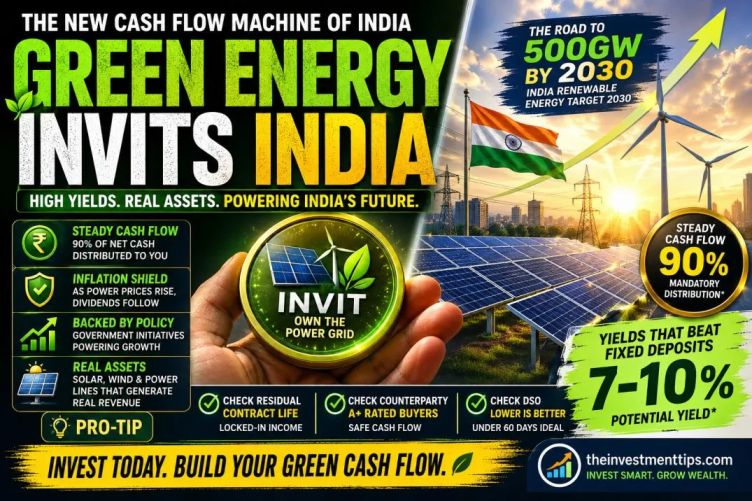
The Indian financial landscape is shifting. For decades, the "Indian Dream" meant gold and real estate. But in 2026, a new titan has emerged: Green Energy InvITs India.
These aren't just for institutional giants anymore. They are the retail investor’s best tool for capturing high yields from India’s massive renewable transition. If you want a portfolio that grows with the future of the grid, you need to understand these trusts.
Quick Summary: Why Invest Now?
- Steady Cash: InvITs must legally pay out 90% of their net cash to you.
- Huge Scale: Backed by the India renewable energy target 2030.
- Inflation Shield: As power prices rise, your dividends usually follow.
What Exactly are Green Energy InvITs?
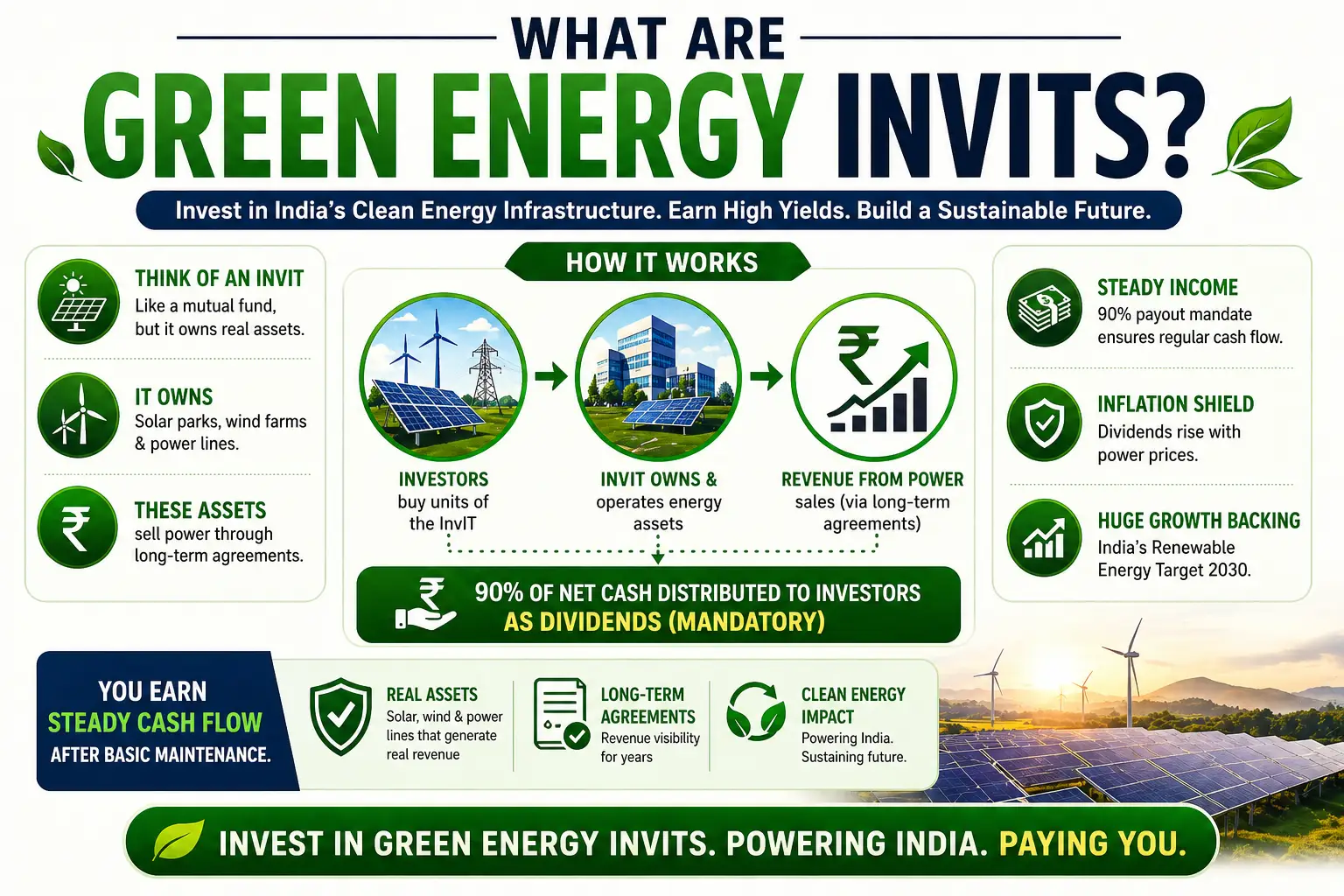
Think of an InvIT (Infrastructure Investment Trust) like a Mutual Fund. But instead of stocks, it owns physical assets—solar parks, wind farms, and power lines.
When you buy units in Green Energy InvITs India, you become a part-owner of the nation’s power grid. These assets sell electricity to the government or big companies. After basic maintenance, that revenue lands in your bank account.
The "Under-the-Hood" View
An InvIT has three main parts:
- The Sponsor: The developer who built the project.
- The Manager: The "brain" making the investment decisions.
- The Trustee: The "watchdog" protecting your money.
Pro-Tip: Always check the Residual Contract Life. If a solar plant has a 15-year contract, your income is essentially "locked in." If it's only 3 years, you’re taking a gamble on future rates.
You may also read :- Best Investing Tips in India: Smart Strategies for 2026
Why 2026 is the Turning Point
The momentum for green energy investment in India is at a fever pitch. Why? Because renewable power is now cheaper to produce than coal.
Real-World Case Study: The "Battery" Shift
In 2024, wind farms were risky because they only worked when the wind blew. By 2026, green energy initiatives in India have pushed "Battery Storage" (BESS) into the mainstream. Now, these farms store power and sell it during the evening peak when prices are highest. More efficiency = higher dividends for you.
The "Hot Take": Forget Diversification
Standard advice says "diversify." Our take? In InvITs, specialization wins. A trust that only owns high-voltage transmission lines often has better margins than a "mixed" trust with old, struggling wind turbines.
The Government "Safety Net"
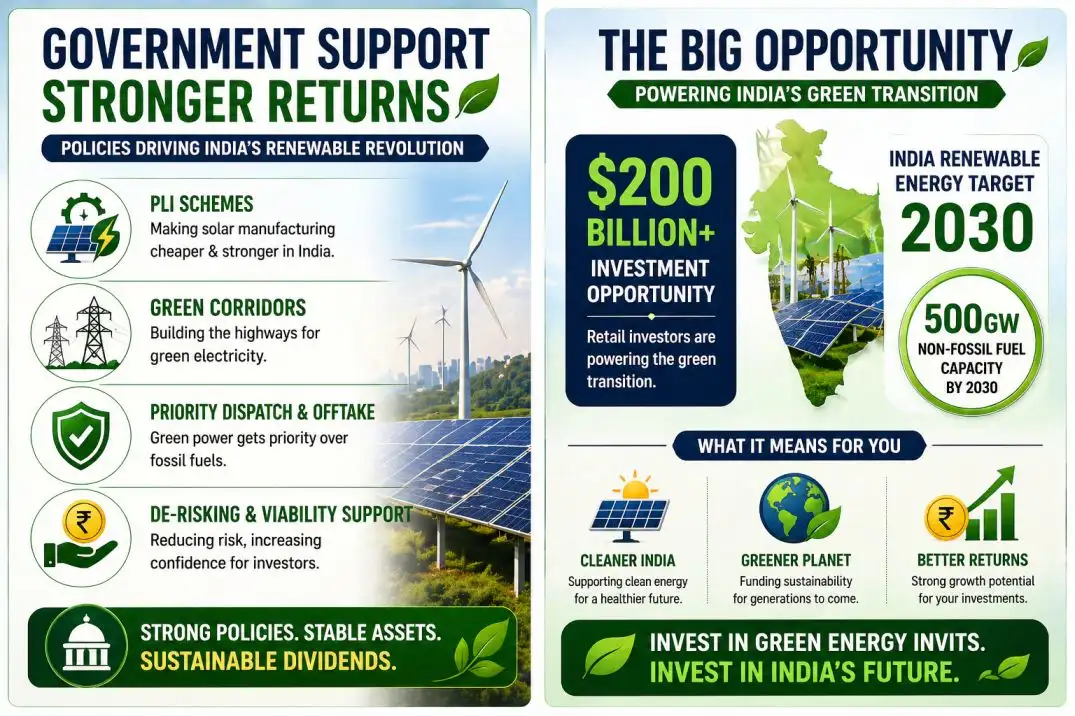
You can’t talk about Green Energy InvITs India without the government initiatives for renewable energy in India. The state isn't just watching; they are de-risking these projects to hit the India renewable energy target 2030.
How the Policy Helps You:
- PLI Schemes: These make solar panels cheaper to build locally.
- Green Corridors: The government is building the "highways" for electricity.
- Direct Support: Policies ensure that green power is bought first, before coal.
Pro-Tip: Don't get blinded by high yields. Look at the "Counterparty." If the InvIT sells power to a bankrupt state electricity board, your dividends might be delayed. Stick to trusts dealing with "A+ Rated" buyers.
Risks You Must Watch
Is it all easy money? No. Green energy investment in India has specific hurdles:
- Interest Rates: If bank rates go up, InvIT prices usually go down.
- Transmission Gaps: If the grid breaks, the solar plant can't sell its power.
- Taxation: Part of your dividend might be taxable, and part might be tax-free. Always check the fine print.
Linguistic Friction (The Insider's Metric)
Check the "Days Sales Outstanding" (DSO). If a trust takes 180 days to collect cash from the government, it's a red flag. You want a trust that collects its cash fast (under 60 days).
The Path to 2030
To reach the India renewable energy target 2030, we need $200 billion in new investment. Banks can't do it alone. Retail investors like you are filling the gap.
By investing in green energy initiatives in India, you are funding the literal de-carbonization of the world's most populous nation. It’s a rare moment where "doing good" actually pays a high dividend.
Final Verdict
The "easy money" in the stock market is getting harder to find. But the "Infrastructure Era" is just starting. By focusing on Green Energy InvITs India, you are putting your money where the growth is.
The Strategy: Don't wait for 2030. By then, the big players will have moved in and driven the yields down. Build your "Green Cash Flow" now, while the market is still waking up.
It works. Until you stop watching the data. Stay sharp.
FAQ: Deep-Dive for the Strategic Investor
Q: Are Green Energy InvITs better than traditional stocks?
A: They serve a different purpose. While tech stocks offer high growth, InvITs are designed for stability and income. Think of them as "Super-Charged Fixed Deposits"—they provide much higher yields than a bank (often 7-10%), but with the added potential for capital appreciation if the asset value grows.
Q: What is the minimum investment required?
A: The barriers have completely fallen. Thanks to recent SEBI regulations, the "lot size" for publicly traded InvITs has been removed, meaning you can often start with the price of a single unit. On platforms like Zerodha or Upstox, this could be as low as ₹100 to ₹500, making it accessible for any budget.
Q: Is the dividend income guaranteed?
A: No investment is truly "guaranteed," but InvITs are as close to predictable as it gets in the market. Their revenue is backed by 25-year Power Purchase Agreements (PPAs) with the government or top-tier corporations. While the payout can fluctuate slightly based on maintenance or weather, the 90% mandatory distribution rule ensures a consistent cash flow.
Q: How is the income from InvITs taxed in India?
A: This is the most critical question. The payout you receive is usually split into three parts: Interest, Dividend, and Repayment of Capital. Interest is typically taxed at your slab rate, while Dividends may be tax-free depending on the trust’s specific tax structure. Always check the "Tax Component" in the trust's quarterly distribution report to calculate your actual take-home.
Q: Can I sell my InvIT units whenever I want?
A: Yes, publicly listed InvITs trade on the NSE and BSE just like regular shares. However, keep in mind that "Liquidity" can vary; some niche green energy trusts may have fewer buyers and sellers on a daily basis. It is best treated as a long-term "Buy and Hold" asset rather than a day-trading instrument.
Q: How does the 2030 Renewable Target affect my investment?
A: It provides a massive "Growth Floor." The Indian government’s push for 500GW of non-fossil fuel capacity by 2030 means these trusts will continuously acquire new solar and wind projects. For you, this means the trust you own today could be twice as large in five years, potentially increasing both your dividend and the unit price.

 in India.webp)