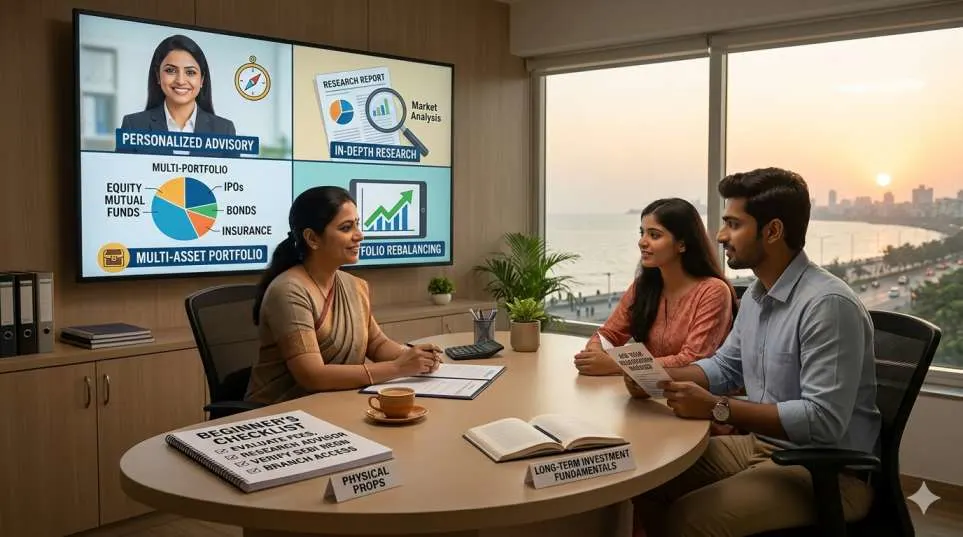
If you live in India and want to buy or sell shares, you will hear a name – full service brokers in India. These are old style stock brokers. They do not just buy or sell your shares. They do many other things. This article talks about what are full service brokers, what work they do, how much they charge, and how they are different from discount brokers. We will also look at top full service stockbrokers in India and their good points and bad points.
Many people in India get confused. They see an ad for a discount broker. They also see an old full service broker like ICICI or HDFC Securities. They do not know which one to pick. This article will help you decide. We will not use hard words. We will not use fake AI style writing. We will talk like a real person explains to his friend.
What Are Full-Service Brokers
A full service broker is a stock broker who gives you many services together. When you open an account with them, you do not just get a place to buy shares. You get research reports, tips, advice, personal relationship manager, and sometimes even tax help. They have physical offices in many cities. You can go and meet them. You can call them and ask – should I buy this stock?
This is different from a discount broker. A discount broker only does one thing – buy or sell your shares at low cost. No advice. No research. No personal meeting. Full service brokers in India started many years ago. Names like Sharekhan, Motilal Oswal, Kotak Securities are full service brokers. They have big teams. They employ analysts who study companies. Then they tell their customers – this stock looks good, buy it.
You may also read :- Open a Brokerage Account in India: Easy Process for Beginners
What Do Full Service Brokers Do

Many new investors ask – what do full service brokers do that is so special? Let me list their work in simple points. But I will not just list. I will explain each one.
First – they open your demat account and trading account. Demat account holds your shares like a locker. Trading account is where you buy and sell. Both come together.
Second – they give research reports. Every week or every month, they send a report to your email. The report says – these three stocks can go up. This sector is doing well. Avoid this company because of bad results. This research is done by their own team. They have MBAs and CFAs who do this work.
Third – they give tips on WhatsApp or phone. Suppose you call your broker and say – I have one lakh rupees. Where to put? He may say – put 40,000 in HDFC Bank, 30,000 in Reliance, and 30,000 in Infosys. This is advice. Discount brokers never give this kind of advice.
Fourth – they manage your portfolio. Portfolio means all your shares together. The broker looks at your shares and says – your portfolio has too much of one sector. Reduce it. Or – sell this share because it is not performing. This service is very useful for busy people.
Fifth – they help in IPO. IPO is when a company first sells its shares to public. Full service brokers help you apply. They tell you if the IPO is good or bad. They also give margin money for IPO in some cases.
Discount Brokers vs Full-Service Brokers in India
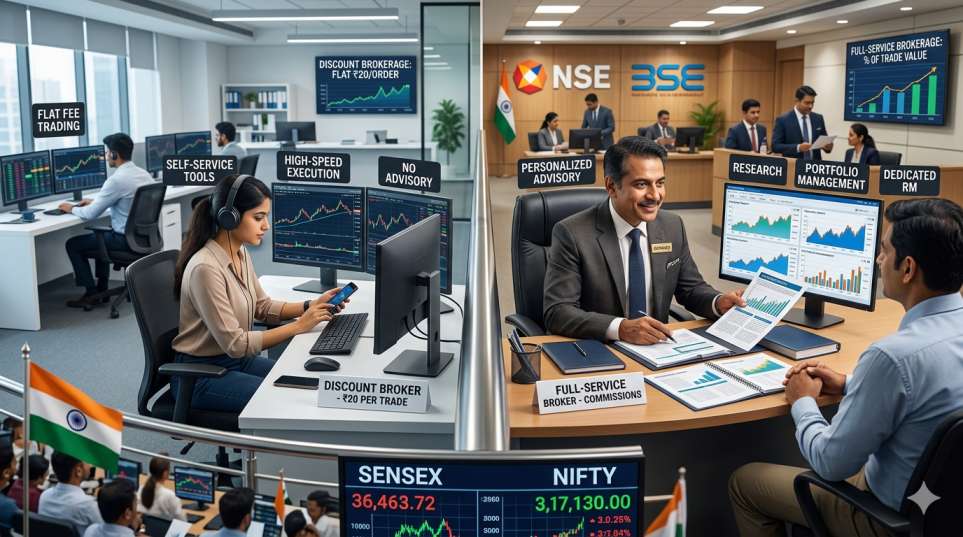
The main difference between these two types of brokers lies in the "service" and the "cost." It is helpful to look at how they compare:
| Feature | Full-Service Brokers | Discount Brokers |
|---|---|---|
| Brokerage Fees | Higher (usually a percentage of trade) | Low (often a flat fee per trade) |
| Personal Advice | Provided by a dedicated manager | Not provided; you decide on your own |
| Research Reports | In-depth reports provided daily | Minimal or basic research |
| Physical Presence | Many branches across India | Mostly online-only presence |
| Ideal For | Beginners or those wanting guidance | Active, experienced traders |
Top Full Service Brokers in India
Now let us talk about top full service brokers in India. These names come again and again. People trust them. They have been in business for many years.
ICICI Direct – This is from ICICI Bank. Very trusted. They have a good trading platform. They give good research. But their cost is on the higher side. They charge account opening fee, annual fee, and high brokerage.
HDFC Securities – This is from HDFC Bank. Same as ICICI Direct. Good service. High cost. Good for people who already bank with HDFC.
Kotak Securities – This is from Kotak Mahindra Bank. They have a nice app called Kotak Stock Trader. Their research team is strong. They give daily calls.
Motilal Oswal – This is a famous name. They started as a full service broker. They have research reports that are very popular. Their motto is – quality over quantity. They focus on long term investing.
Sharekhan – Sharekhan is now part of BNP Paribas. They have many branches in small cities too. They are known for good customer service. Their research is good for beginners.
IIFL Securities – IIFL has offices everywhere. They give a lot of calls. Their research is simple and easy to understand. But some customers say their charges are not fully clear.
So these are top full service stock brokers India. Each has good and bad. Do not just pick any name. Talk to them. Ask them – how much will you charge for one lakh trade? Then decide.
Full Service Brokers Charges in India

Now the most important part – full service brokers charges in India. Many people do not check charges properly. Then they get a big bill at end of month. Let me break charges into small pieces.
Brokerage – This is the main charge. For full service brokers, it is usually a percentage. Example – Motilal Oswal takes 0.2% for delivery buying. That means if you buy shares worth one lakh and hold for more than one day, you pay Rs 200. Some brokers take 0.5% also.
Demat account annual maintenance charge – Every year you pay for the demat account. It is like rent. Usually Rs 300 to Rs 800 per year. Some brokers give first year free.
Account opening charge – Some brokers take Rs 500 to Rs 1000 when you open account. Some do not take anything. Always ask – account opening free hai ya paid?
Transaction charge – This is a small charge per trade. Usually Rs 10 to Rs 20 per trade. Discount brokers also take this. But full service brokers take a little more.
Call and trade charge – If you call your broker and ask him to buy shares for you on phone, they take extra charge. Usually Rs 20 to Rs 50 per call. So better to do online yourself.
Advantages and Disadvantages of Full-Service Brokers
Advantages
- Expert Guidance: You do not have to guess which stocks to buy. Experts do the hard work for you.
- Convenience: From wealth management to tax planning, you can get all your financial needs met in one place.
- Trust: These firms have been in business for decades and are regulated, which makes them very safe for your investments.
- Human Support: If you face a technical issue or need help with a transaction, you can speak to a person, not just a chatbot.
Disadvantages
- Higher Costs: The biggest drawback is the commission, which can eat into your profits if you trade very frequently.
- Conflict of Interest: Sometimes, a broker might suggest a product because they get a higher commission, not necessarily because it is the best for you.
- Over-reliance: Some beginners rely too much on the broker and never learn how to research stocks themselves.
Final Words
Full service brokers in India are old and trusted. They give good advice and many services. But their cost is high. You must decide based on your own needs. Do not blindly follow anyone. Talk to two or three brokers. Ask them – what is your charge for one lakh rupees? What is the annual fee? Do you give free research? Then decide.
If you are a beginner and you want hand holding, go with a top full service stock brokers India like ICICI Direct, HDFC Securities, Motilal Oswal, or Sharekhan. Use them for one year. Learn the market. Then if you want lower cost, shift to a discount broker later. That is a smart way.
 in India.webp)